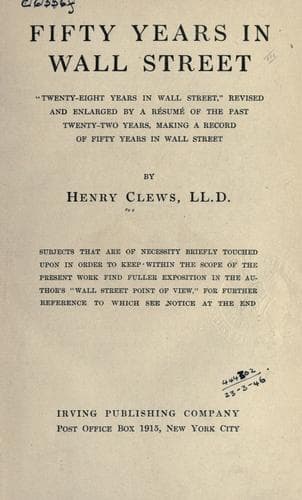
Business; Capitalists and financiers -- United States; Speculation; Wall Street (New York, N.Y.)
“If it is the intention of the Legislature of this State to stop
enterprise in business, then your Committee is undertaking to accomplish
that work in the right way, but I think your success would be a public
calamity.”
I doubt the expediency of either undertaking to regulate enterprise by
law or to choke off competition by the law-making power. The result
would be woeful stagnation in business. It would crush the motives for
commercial activity and depress the creative energies of prosperity.
The law of supply and demand is the best regulator.
Congress attempted to suppress speculation in gold during the war, and
as soon as the act was passed prohibiting such dealings, the premium on
gold advanced 100 per cent. This so much terrified the wise statesmen
who concocted this sweeping measure of financial reform, that they
immediately displayed much more wisdom in hastening to have the bill
repealed.
The simple reason that such laws will not work in practice is that where
there is a will there is generally a way to evade them. This is the case
with the very best of such laws that can possibly be framed. Take the
usury laws for example. The methods of getting around these are
numerous, and there is practically no limit to the rate of interest that
can be exacted except the conscience of the lender, which is frequently
very elastic. Daniel O’Connell said he could drive a coach and six
through any act of Parliament. Jake Sharp was also of opinion that he
could run a double-track horse-car railroad through the best act that
could be framed by any Albany Legislature. Jake was checked in his
career at considerable trouble and expense, but his case illustrated
that the rule referred to holds good generally in legislation.
The fact, however, that it seldom happens that anybody gets badly hurt
in “corners,” except the conspirators themselves, is sufficient
protection for the general public, and should set the minds of
legislators at rest, if they mean to do legitimate business in their
law-making capacity.
The conspirators in “corners” are usually left high and dry without any
market for their fictitious values, and the “corner” very frequently has
the effect of putting the property out of the speculative market for a
long time. The fate of Han. & St. Jo. is a warning to those who
manipulate “corners.” The stock was seldom quoted for months afterwards.
Take the case of Black Friday for example. It was most disastrous to the
parties intimately connected with it. It came near proving Gould’s ruin,
and he has not got over the moral effect of it yet. The probability is
it will be an heirloom in his family, a skeleton in the Gould closet for
generations to come. Gould and Black Friday have become synonymous in
the minds of many people, and the further from Wall Street the more the
distinction becomes confounded.
Public-domain text, read in full here on John Shaqi.
Reviews
Reviews
No reviews yet
Be the first to share your thoughts on this work.
Elsewhere in the archive
Join the Discussion
Join the discussion
Sign in to leave a comment or review.
Sign InorCreate an account