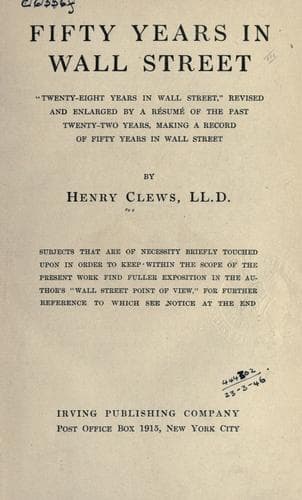
Business; Capitalists and financiers -- United States; Speculation; Wall Street (New York, N.Y.)
“Speculation, moreover, makes a market for securities that otherwise
would not exist. It enables railroads to be built through the ready sale
of their bonds, thus adding materially to the wealth of the whole
country, and opening a more profitable market to labor. In this it
becomes the forerunner of enterprise and material prosperity in
business.
“There are ‘corners’ in all kinds of business as well as in Wall Street
speculation. Mr. A. T. Stewart, the great dry goods merchant, made more
‘corners’ during the latter part of his life than half the rest of the
business community put together. He did this mainly by contracting for
the entire and exclusive production of certain classes of goods, and as
such goods could only be bought at his establishment he had a close
‘corner’ in them, and accordingly put on his own prices.
“The greater portion of all the large mercantile firms do business in
the same way. And all the importing firms deal in futures. They sell
goods by sample, agreeing to deliver them at a future stated period,
varying from thirty days to twelve months. In the meantime the goods
have to be manufactured, and in many instances purchasers have to wait
until they are grown, and imported thousands of miles.
“If it were not for the support which comes from the ‘short’ interest in
grain and the general activity created thereby in times of depression,
which come periodically in this country, it would be in the power of the
large speculative grain dealers in Europe to manipulate prices downward,
and purchase our products every year, on raids, at prices much under the
cost of production.
“When we sell to Europe we must do so at a profit, or our transactions
don’t help to enrich the country.
“Another curious thing about ‘corners’ is that the people who organize
and manipulate them generally get most hurt in the enterprise. This was
the case with the ‘corner’ referred to in Hannibal and St. Joseph. Mr.
John Duff, of Boston, was the man in whose prolific brain that ‘corner’
originated, and the result to him was financial ruin. The stock ran up
to 350, though the short account amounted to only about 1,200 shares,
and the ‘shorts’ had to settle at 280.
“The result was similar in the ‘corner’ in Northwest in 1872,
manipulated by Jay Gould. The stock was started at 80 and it ran up to
280. It then reacted to the former figure. I believe Jay Gould was alone
in that deal, and it came pretty near crushing him, in spite of his
incomparable capacity for wriggling out of a tight place.
“Patents are ‘corners’ protected by law. The inventor has a monopoly for
seventeen years in his invention against all the world, and this gives
him a right to make and sell the article covered by his patent, often at
a profit of several hundred per cent. on the original cost, and on the
price it would bring if placed in competition in the open market, like
railroad stocks and grain.
Public-domain text, read in full here on John Shaqi.
Reviews
Reviews
No reviews yet
Be the first to share your thoughts on this work.
Elsewhere in the archive
Join the Discussion
Join the discussion
Sign in to leave a comment or review.
Sign InorCreate an account