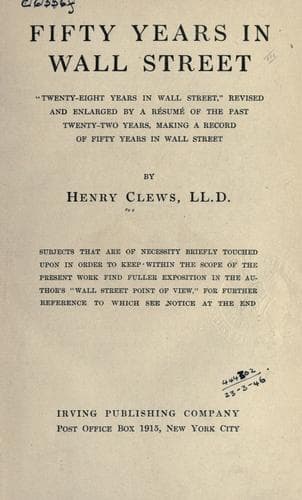
Business; Capitalists and financiers -- United States; Speculation; Wall Street (New York, N.Y.)
This Sovereign State issued and granted altogether about eight millions
of bonds, all bearing the great seal, properly signed and legally issued
for full value. I advanced over two million dollars in good money on a
part of these bonds. Shortly after this transaction, the State of
Georgia ascertained through a garbled report of a committee sent to this
city by the Georgia Legislature, that all these bonds were held outside
of her own borders. The Legislature then passed an act of repudiation,
thereby reducing the value of the bonds from par to that of waste paper.
When I discovered that my little pile of two million dollars in what I
considered good securities would no longer exchange for greenbacks, I
had a very disagreeable sensation of having been “cornered” by the high
toned and chivalrous representatives of the State of Georgia, which,
through its lawmakers, claimed the sovereign right to do wrong to the
citizens of a sister State.
In the Harlem “corner,” which is referred to in another place, contracts
to deliver at 110 were settled at 179.
About three million dollars were taken out of the pockets of the bears.
Several prominent houses went down in the struggle. The result of the
“corner” was that the bulls were saddled with the entire capital stock
of the property.
One broker, who had sold calls at 150 and was requested to fulfil his
contracts when the stock had advanced to 250, was very much in the same
position as Glendower’s spirits, which were called from the vasty deep
but would not come. “I don’t see anything here,” he said, “about
delivering. You can call, but I don’t mind it.”
There were two “corners” in Harlem. The Common Council was cornered in
one and the Legislature in the other.
In the Rock Island “corner” the bulls bought 20,000 shares more than
existed, and the price rose from 110 to 150.
London financiers have a fearful horror of “corners.” Hence the London
Stock Exchange is very chary about listing our railroads, especially
those with a moderate number of shares.
“Corners” are seldom profitable, and the parties connected with them can
hardly escape getting badly hurt unless they are prepared to own and
carry the entire property. Even in that event, it is usually put out of
the speculative market for a considerable time.
The Hudson “corner” was one of the most successful. It paid a profit of
12 per cent. There was a profit of 4½ on the Rock Island “corner.”
The first “corner” of which there is any record in Wall Street was in
Morris Canal, an old “fancy” now almost forgotten except for its
“corner.” It had been forced upward as fancies frequently are, until it
was far above its intrinsic value, and several operators began to sell
“short.”
Public-domain text, read in full here on John Shaqi.
Reviews
Reviews
No reviews yet
Be the first to share your thoughts on this work.
Elsewhere in the archive
Join the Discussion
Join the discussion
Sign in to leave a comment or review.
Sign InorCreate an account