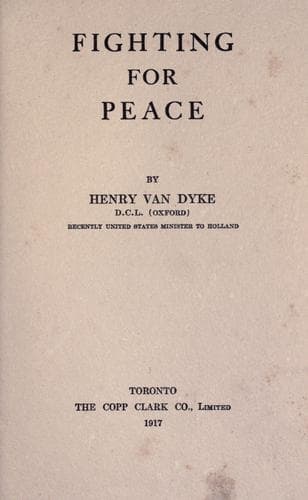
World War, 1914-1918 -- Germany; World War, 1914-1918 -- Personal narratives
The following chapters narrate some of the experiences--things seen and
heard and studied during my years of service abroad--which have forced
me to this conclusion. To the articles which were published in
Scribner's Magazine for September, October, and November, 1917, I have
added two short chapters on the cause of the war and the kind of peace
America is fighting for.
The third peace conference is more needed, more desirable, than ever.
But we shall never get it until the military forces of Germany are
broken, and the predatory Potsdam gang which rules them is brought low.
Chapter I
FAIR-WEATHER AND STORM SIGNS
I
It takes a New England farmer to note and interpret the signs of coming
storm on a beautiful and sunny day. Perhaps his power is due in part to
natural sharpness, and in part to the innate pessimism of the Yankee
mind, which considers the fact that the hay is cut but not yet in the
barn a sufficient reason for believing that "it'll prob'ly rain
t'morrow."
I must confess that I had not enough of either of these qualities to be
observant and fearful of the presages of the oncoming tempest which
lurked in the beautiful autumn and winter of 1913-14 in Europe. Looking
back at them now, I can see that the signs were ominous. But anybody can
be wise after the event, and the role of a reminiscent prophet is too
easy to be worth playing.
Certainly all was bright and tranquil when we rolled through the
pleasant land of France and the rich cities of Belgium, and came by
ship-thronged Rotterdam to The Hague in the first week of October, 1913.
Holland was at her autumnal best. Wide pastures wonderfully green were
full of drowsy, contented cattle. The level brown fields and gardens
were smoothly ploughed and harrowed for next year's harvest, and the
vast tulip-beds were ready to receive the little gray bulbs which would
overflow April with a flood-tide of flowers. On the broad canals
innumerable barges and sloops and motor-boats were leisurely passing,
and on the little side-canals and ditches which drained the fields the
duckweed spread its pale-emerald carpet undisturbed. In the woods--the
tall woods of Holland--the elms and the lindens were putting on frosted
gold, and the massy beeches glowed with ruddy bronze in the sunlight.
The quaint towns and villages looked at themselves in the waters at
their feet and were content. Slowly the long arms of the windmills
turned in the suave and shimmering air. Everybody, in city and country,
seemed to be busy without haste. And overhead, the luminous cloud
mountains--the poor man's Alps--marched placidly with the wind from
horizon to horizon.
Public-domain text, read in full here on John Shaqi.
Reviews
Reviews
No reviews yet
Be the first to share your thoughts on this work.
Join the Discussion
Join the discussion
Sign in to leave a comment or review.
Sign InorCreate an account