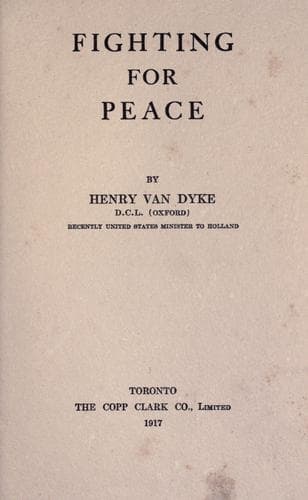
World War, 1914-1918 -- Germany; World War, 1914-1918 -- Personal narratives
"Quite so," I answered, "and thank God for that! But suppose you had a
quarrel with a neighbor in the Rheinland, who had positively declined a
proposition which you had made to him. And suppose, the ordinary
post-boy services being interrupted, you asked me to convey to your
neighbor a note which began by addressing him as a 'silly s-- of a
b----,' and ended by telling him that if he did not agree you would
certainly grind him to powder. Would you expect me to play the post-boy
for such a billet-doux on the ground that I was not responsible for its
contents and was a friend of both parties?"
"Well," replied the counsellor, laughing at the North American
directness of my language, "probably not." So he folded up the note and
took it away. What became of it I do not know nor care.
The third request was of still another quality. It came from the
Imperial Austro-Hungarian Legation, which very politely asked me to
transmit a message in the American diplomatic code to my colleague in
Brussels for delivery to the Austro-Hungarian Legation, which still
lingered in that city. The first and last parts of the message were in
plain language, good English, quite innocent and proper. But the kernel
of the despatch was written in the numerical secret cipher of Vienna,
which of course I was unable to read. I drew attention to this, and
asked mildly how I could be expected to put this passage into our code
without knowing what the words were. The answer was that it would not be
necessary to code this passage; it could be transmitted in numbers just
as it stood; the Austro-Hungarian charge d'affaires at Brussels would
understand it.
"Quite so," I answered, "but you see the point is that I do not
understand it. My dear count, you are my very good friend, and it
grieves me deeply to decline any requests of yours. But the simple fact
is that our instructions explicitly forbid us to send any message in two
codes."
The count--who, by the way, was an excellent and most amiable man--
blushed and stammered that he was only carrying out the instructions of
his chief, but that my point was perfectly clear and indisputable. I was
glad that he saw it in that light, and we parted on the most friendly
terms. What became of the message I do not know nor care.
It was about the 1st of September, 1915, that I came into brief contact
with the case of Mr. J. F. J. Archibald. This gentleman was an American
journalist, and a very clever and agreeable man. We had met some months
before, when he was on his way back to America from his professional
work in Germany, and he had been a welcome guest at my table. But the
second meeting was different.
Public-domain text, read in full here on John Shaqi.
Reviews
Reviews
No reviews yet
Be the first to share your thoughts on this work.
Elsewhere in the archive
Join the Discussion
Join the discussion
Sign in to leave a comment or review.
Sign InorCreate an account