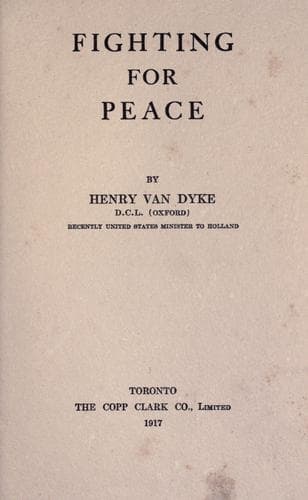
World War, 1914-1918 -- Germany; World War, 1914-1918 -- Personal narratives
This last point lies at the base of President Wilson's note of December
18, 1916, suggesting that the belligerent powers, on both sides, should
"avow their respective views as to the terms upon which the war might be
concluded and the arrangements which would be deemed satisfactory as a
guarantee against its renewal or the kindling of any similar conflict in
the future." This note, I believe, was sent to all the American
Ambassadors and Ministers in Europe, with instructions to communicate it
to the Governments to which they were accredited, whether belligerent or
neutral.
Here is a point at which I can throw a little new light upon the
situation. I handed the note, as I was ordered to do, to the Dutch
Minister, without comment or recommendation. Almost immediately the
German-subsidized press in Holland began to assail the Dutch Government
for refusing to support President Wilson's note. It seemed to me that
this was a falsehood, unjust to Holland, injurious to our Government,
which had not asked for support. Therefore I made the following
statement to the press on January 9, 1917:
"The Dutch Minister of Foreign Affairs is absolutely correct in saying
that I handed him President Wilson's note of December 18 without any
request or suggestion that the Netherlands Government should support it.
I did so because I was so instructed by my Government. I was told to
transmit the President's note simply as a matter of information. No
request was added. The reason for this is because America understands
the delicate and difficult position of the Netherlands Government, in
the midst of the present war, and will not urge nor even ask it to do
anything which it does not judge to be wise and prudent and helpful. I
have done my best to promote this right understanding of the position of
Holland in the United States, and I shall continue to do so. I have no
knowledge of any instructions from Washington in regard to the manner of
delivering the President's note in Spain.
"What I cannot understand is the general misunderstanding of that note.
It expressly declared that it was not an offer of mediation nor a
proposal of peace. It was simply a suggestion that the belligerents on
both sides should state the terms on which they would be willing to
consider and discuss peace. The Entente Powers have already done this
with some clearness, and will probably soon do so even more clearly. The
Central Powers have politely, even affectionately, but very practically,
declined the President's invitation to state their terms. There is the
deadlock on peace talk at present. When both sides are equally frank the
world can judge whether the peace which all just men desire is near or
far away."
The accuracy and propriety of this statement have never been questioned
by the Department of State. On the contrary, it was practically affirmed
by the President in his address to the Senate on January 22, 1917, when
he said:
Public-domain text, read in full here on John Shaqi.
Reviews
Reviews
No reviews yet
Be the first to share your thoughts on this work.
Elsewhere in the archive
Join the Discussion
Join the discussion
Sign in to leave a comment or review.
Sign InorCreate an account