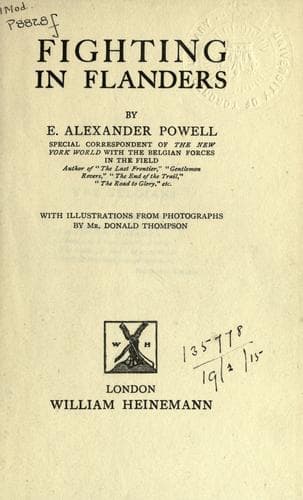
Fighting in FlandersPowell, E. Alexander (Edward Alexander)
History
Fighting in Flanders
Powell, E. Alexander (Edward Alexander)
World War, 1914-1918 -- Campaigns -- Belgium
There is one other person of whom passing mention should be
made, if for no other reason than because his name will appear
from time to time in this narrative. I take pleasure, therefore, in
introducing you to M. Marcel Roos, the young Belgian gentleman
who drove my motor-car. When war was declared, Roos, who
belonged to the jeunesse doree of Brussels, gave his own ninety
horse-power car to the Government and enlisted in a regiment of
grenadiers. Because he was as familiar with the highways and
byways of Belgium as a housewife is with her kitchen, and because
he spoke English, French, Flemish and German, he was detailed to
drive the car which the Belgian Government placed at my disposal.
He was as big and loyal and good-natured as a St. Bernard dog and
he was as cool in danger as Thompson--which is the highest
compliment I can pay him. Incidentally, he was the most successful
forager that I have ever seen; more than once, in villages which had
apparently been swept clean of everything edible by the Belgians or
the Germans, he produced quite an excellent dinner as mysteriously
as a conjuror produces rabbits from a hat.
Now you must bear in mind that although one could get into
Antwerp with comparative ease, it by no means followed that one
could get out to the firing-line. A long procession of correspondents
came to Antwerp and remained a day or so and then went away
again without once getting beyond the city gates. Even if one
succeeded in obtaining the necessary laisser-passer from the
military Government, there was no way of reaching the front, as all
the automobiles and all except the most decrepit horses had been
requisitioned for the use of the army. There was, you understand,
no such thing as hiring an automobile, or even buying one. Even the
few people who had influence enough to retain their cars found
them useless, as one of the very first acts of the military authorities
was to commandeer the entire supply of petrol. The bulk of the cars
were used in the ambulance service or for purposes of transport,
the army train consisting entirely of motor vehicles. Staff officers,
certain Government officials, and members of the diplomatic and
consular corps were provided by the Government with automobiles
and military drivers. Every one else walked or used the trams. Thus
it frequently happened that a young staff officer, who had never
before known the joys of motoring, would tear madly down the street
in a luxurious limousine, his spurred boots resting on the broadcloth
cushions, while the ci-devant owner of the car, who might be a
banker or a merchant prince, would jump for the side-walk to
escape being run down. With the declaration of war and the taking
over of all automobiles by the military, all speed laws were flung to
the winds.
Public-domain text, read in full here on John Shaqi.
Reviews
Reviews
No reviews yet
Be the first to share your thoughts on this work.
Join the Discussion
Join the discussion
Sign in to leave a comment or review.
Sign InorCreate an account