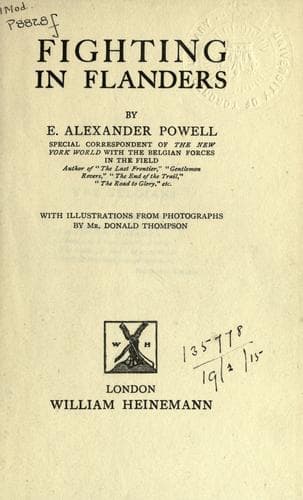
Fighting in FlandersPowell, E. Alexander (Edward Alexander)
History
Fighting in Flanders
Powell, E. Alexander (Edward Alexander)
World War, 1914-1918 -- Campaigns -- Belgium
In order to grasp the true significance of the events which preceded
and led up to the fall of Antwerp, it is necessary to understand the
extraordinary conditions which existed in and around that city when I
reached there in the middle of August. At that time all that was left to
the Belgians of Belgium were the provinces of Limbourg, Antwerp,
and East and West Flanders. Everything else was in the possession
of the Germans. Suppose, for the sake of, having things quite clear,
that you unfold the map of Belgium. Now, with your pencil, draw a
line across the country from east to west, starting at the Dutch city
of Maastricht and passing through Hasselt, Diest, Aerschot, Malines,
Alost, and Courtrai to the French frontier. This line was, roughly
speaking, "the front," and for upwards of two months fighting of a
more or less serious character took place along its entire length.
During August and the early part of September this fighting
consisted, for the most part, of attempts by the Belgian field army to
harass the enemy and to threaten his lines of communication and of
counter-attacks by the Germans, during which Aerschot, Malines,
Sempst, and Termonde repeatedly changed hands. Some twenty
miles or so behind this line was the great fortified position of
Antwerp, its outer chain of forts enclosing an area with a radius of
nearly fifteen miles.
Antwerp, with its population of four hundred thousand souls, its
labyrinth of dim and winding streets lined by mediaeval houses, and
its splendid modern boulevards, lies on the east bank of the
Scheldt, about fifteen miles from Dutch territorial waters, at a
hairpin-turn in the river. The defences of the city were modern,
extensive, and generally believed, even by military experts, to be
little short of impregnable. In fact, Antwerp was almost universally
considered one of the three or four strongest fortified positions in
Europe. In order to capture the city it would be necessary for an
enemy to break through four distinct lines of defence, any one of
which, it was believed, was strong enough to oppose successfully
any force which could be brought against it. The outermost line of
forts began at Lierre, a dozen miles to the south-east of the city,
and swept in a great quarter-circle, through Wavre-St. Catherine,
Waelhem, Heyndonck and Willebroeck, to the Scheldt at Ruppelmonde.
Public-domain text, read in full here on John Shaqi.
Reviews
Reviews
No reviews yet
Be the first to share your thoughts on this work.
Join the Discussion
Join the discussion
Sign in to leave a comment or review.
Sign InorCreate an account