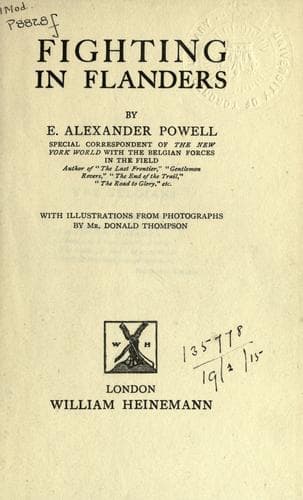
Fighting in FlandersPowell, E. Alexander (Edward Alexander)
History
Fighting in Flanders
Powell, E. Alexander (Edward Alexander)
World War, 1914-1918 -- Campaigns -- Belgium
As a result of these elaborate precautions, it was as difficult to go
in or out of Antwerp as it is popularly supposed to be for a millionaire
to enter the kingdom of Heaven. Sentries were as thick as policemen
in Piccadilly. You could not proceed a quarter of a mile along any
road, in any direction, without being halted by a harsh "Qui vive?"
and having the business end of a rifle turned in your direction. If
your papers were not in order you were promptly turned back--or
arrested as a suspicious character and taken before an officer for
examination--though if you were sufficiently in the confidence of the
military authorities to be given the password, you were usually
permitted to pass without further question. It was some time before
I lost the thrill of novelty and excitement produced by this
halt-who-goes-there-advance-friend-and-give-the-countersign business.
It was so exactly the sort of thing that, as a boy, I used to read
about in books by George A. Henty that it seemed improbable and unreal.
When we were motoring at night and a peremptory challenge would
come from out the darkness and the lamps of the car would pick out
the cloaked figure of the sentry as the spotlight picks out the figure
of an actor on the stage, and I would lean forward and whisper the
magic mot d'ordre, I always had the feeling that I was taking part in
a play-which was not so very far from the truth, for, though I did not
appreciate it at the time, we were all actors, more or less important,
in the greatest drama ever staged.
In the immediate vicinity of Antwerp the sentries were soldiers of the
regular army and understood a sentry's duties, but in the outlying
districts, particularly between Ostend and Ghent, the roads were
patrolled by members of the Garde civique, all of whom seemed
imbued with the idea that the safety of the nation depended upon
their vigilance, which was a very commendable and proper attitude
indeed. When I was challenged by a Garde civique I was always a
little nervous, and wasted no time whatever in jamming on the
brakes, because the poor fellows were nearly always excited and
handled their rifles in a fashion which was far from being reassuring.
More than once, while travelling in the outlying districts, we were
challenged by civil guards who evidently had not been entrusted
with the password, but who, when it was whispered to them, would
nod their heads importantly and tell us to pass on.
"The next sentry that we meet," I said to Roos on one of these
occasions, "probably has no idea of the password. I'll bet you a box
of cigars that I can give him any word that comes into my head and
that he won't know the difference."
As we rolled over the ancient drawbridge which gives admittance to
sleepy Bruges, a bespectacled sentry, who looked as though he
had suddenly been called from an accountant's desk to perform the
duties of a soldier, held up his hand, palm outward, which is the
signal to stop the world over.
Public-domain text, read in full here on John Shaqi.
Reviews
Reviews
No reviews yet
Be the first to share your thoughts on this work.
Join the Discussion
Join the discussion
Sign in to leave a comment or review.
Sign InorCreate an account