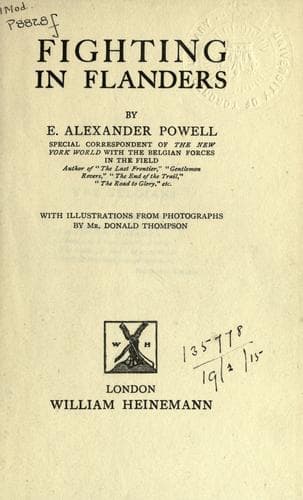
Fighting in FlandersPowell, E. Alexander (Edward Alexander)
History
Fighting in Flanders
Powell, E. Alexander (Edward Alexander)
World War, 1914-1918 -- Campaigns -- Belgium
An American, I went to Belgium at the beginning of the war with an open
mind. I had few, if any, prejudices. I knew the English, the French,
the Belgians, the Germans equally well. I had friends in all four
countries and many happy recollections of days I had spent in each.
When I left Antwerp after the German occupation I was as pro-Belgian
as though I had been born under the red-black-and-yellow banner. I had
seen a country, one of the loveliest and most peaceable in Europe,
invaded by a ruthless and brutal soldiery; I had seen its towns and
cities blackened by fire and broken by shell; I had seen its churches
and its historic monuments destroyed; I had seen its highways crowded
with hunted, homeless fugitives; I had seen its fertile fields strewn
with the corpses of what had once been the manhood of the nation; I
had seen its women left husbandless and its children left fatherless;
I had seen what was once a Garden of the Lord turned into a land of
desolation; and I had seen its people--a people whom I, like the rest
of the world, had always thought of as pleasure-loving, inefficient,
easy-going--I had seen this people, I say, aroused, resourceful,
unafraid, and fighting, fighting, fighting. Do you wonder that they
captured my imagination, that they won my admiration? I am pro-Belgian;
I admit it frankly. I should be ashamed to be anything else.
E. Alexander Powell
London, November 1, 1914.
I. The War Correspondents
War correspondents regard war very much as a doctor regards
sickness. I don't suppose that a doctor is actually glad that people
are sick, but so long as sickness exists in the world he feels that he
might as well get the benefit of it. It is the same with war
correspondents. They do not wish anyone to be killed on their
account, but so long as men are going to be killed anyway, they
want to be on hand to witness the killing and, through the
newspapers, to tell the world about it. The moment that the war
broke out, therefore, a veritable army of British and American
correspondents descended upon the Continent. Some of them were
men of experience and discretion who had seen many wars and
had a right to wear on their jackets more campaign ribbons than
most generals. These men took the war seriously. They were there
to get the news and, at no matter what expenditure of effort and
money, to get that news to the end of a telegraph-wire so that the
people in England and America might read it over their coffee-cups
the next morning. These men had unlimited funds at their disposal;
they had the united influence of thousands of newspapers and of
millions of newspaper-readers solidly behind them; and they carried
in their pockets letters of introduction from editors and ex-presidents
and ambassadors and prime ministers.
Public-domain text, read in full here on John Shaqi.
Reviews
Reviews
No reviews yet
Be the first to share your thoughts on this work.
Join the Discussion
Join the discussion
Sign in to leave a comment or review.
Sign InorCreate an account