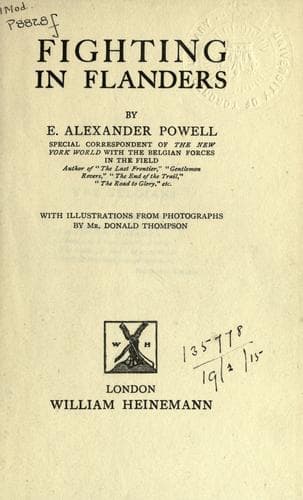
Fighting in FlandersPowell, E. Alexander (Edward Alexander)
History
Fighting in Flanders
Powell, E. Alexander (Edward Alexander)
World War, 1914-1918 -- Campaigns -- Belgium
Throughout the operations around Antwerp, the Taubes, as
the German aeroplanes are called because of their fancied
resemblance to a dove, repeatedly performed daring feats of
reconnaissance. On one occasion, while I was with the General
Staff at Lierre, one of these German Taubes sailed directly over the
Hotel de Ville, which was being used as staff headquarters. It so
happened that King Albert was standing in the street, smoking one
of the seven-for-a-franc Belgian cigars to which he was partial.
"The Germans call it a dove, eh?" remarked the King, as he looked
up at the passing aircraft. "Well, it looks to me more like a hawk."
A few days before the fall of Antwerp a Taube flew over the city in
the early afternoon, dropping thousands of proclamations printed in
both French and Flemish and signed by the commander of the
investing forces, pointing out to the inhabitants the futility of
resistance, asserting that in fighting Germany they were playing
Russia's game, and urging them to lay down their arms. The
aeroplane was greeted by a storm of shrapnel from the high-angle
guns mounted on the fortifications, the only effect of which,
however, was to kill two unoffending citizens who were standing in
the streets and were struck by the fragments of the falling shells.
Most people seem to have the impression that it is as easy for an
aviator to see what is happening on the ground beneath him as
though he were looking down from the roof of a high building. Under
ordinary conditions, when one can skim above the surface of the
earth at a height of a few hundred feet, this is quite true, but it is
quite a different matter when one is flying above hostile troops who
are blazing away at him with rifles and machine-guns. During
reconnaissance work the airmen generally are compelled to ascend
to an altitude of a mile or a mile and a quarter, which makes
observation extremely difficult, as small objects, even with the aid of
the strongest glasses, assume unfamiliar shapes and become fore-
shortened. If, in order to obtain a better view, they venture to fly at a
lower height, they are likely to be greeted by a hail of rifle fire from
soldiers in the trenches. The Belgian aviators with whom I talked
assured me that they feared rifle fire more than bursting shrapnel,
as the fire of a regiment, when concentrated even on so elusive an
object as an aeroplane, proves far more deadly than shells.
The Belgians made more use than any other nation of motor-cars.
When war was declared one of the first steps taken by the military
authorities was to commandeer every motor-car, every motor-cycle
and every litre of petrol in the kingdom. As a result they depended
almost entirely upon motor-driven vehicles for their military
transport, which was, I might add, extremely efficient. In fact, we
could always tell when we were approaching the front by the
amazing number of motor-cars which lined the roads for miles in the
rear of each division.
Public-domain text, read in full here on John Shaqi.
Reviews
Reviews
No reviews yet
Be the first to share your thoughts on this work.
Join the Discussion
Join the discussion
Sign in to leave a comment or review.
Sign InorCreate an account