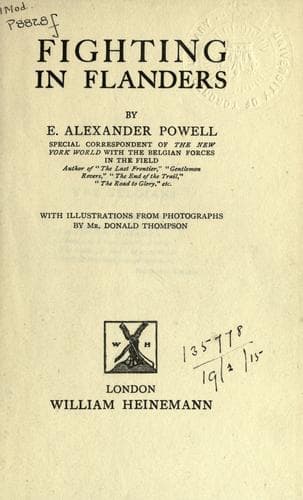
Fighting in FlandersPowell, E. Alexander (Edward Alexander)
History
Fighting in Flanders
Powell, E. Alexander (Edward Alexander)
World War, 1914-1918 -- Campaigns -- Belgium
Just as there are two versions of the destruction of Aerschot, so
there are two versions, though in this case widely different, of the
events which led up to the destruction of Louvain. It should be borne
in mind, to begin with, that Louvain was not destroyed by
bombardment or in the heat of battle, for the Germans had entered
it unopposed, and had been in undisputed possession for several
days. The Germans assert that a conspiracy, fomented by the
burgomaster, the priests and many of the leading citizens, existed
among the townspeople, who planned to suddenly fall upon and
exterminate the garrison. They claim that, in pursuance of this plan,
on the night of August 26, the inhabitants opened a murderous fire
upon the unsuspecting troops from house-tops, doors and windows;
that a fierce street battle ensued, in which a number of women and
children were unfortunately killed by stray bullets; and that, in
retaliation for this act of treachery, a number of the inhabitants were
executed and a portion of the city was burned. Notwithstanding the
fact that, as soon as the Germans entered the city, they searched it
thoroughly for concealed weapons, they claim that the townspeople
were not only well supplied with rifles and ammunition, but that they
even opened on them from their windows with machine-guns.
Though it seems scarcely probable that the inhabitants of Louvain
would attempt so mad an enterprise as to attack an overwhelming
force of Germans--particularly with the terrible lesson of Aerschot
still fresh in their minds--I do not care to express any opinion as to
the truth of the German assertions.
Public-domain text, read in full here on John Shaqi.
Reviews
Reviews
No reviews yet
Be the first to share your thoughts on this work.
Join the Discussion
Join the discussion
Sign in to leave a comment or review.
Sign InorCreate an account