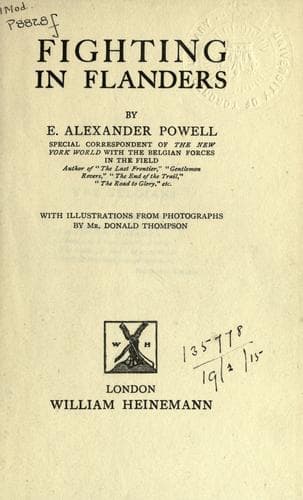
Fighting in FlandersPowell, E. Alexander (Edward Alexander)
History
Fighting in Flanders
Powell, E. Alexander (Edward Alexander)
World War, 1914-1918 -- Campaigns -- Belgium
It was really a Pittsburg chauffeur who was primarily responsible for
my being invited to dine with the commander of the Ninth German
Army. The chauffeur's name was William Van Calck and his
employer was a gentleman who had amassed several millions
manufacturing hats in the Smoky City. When war was declared the
hat-manufacturer and his family were motoring in Austria, with Van
Calck at the wheel of the car. The car being a large and powerful
one, it was promptly commandeered by the Austrian military
authorities; the hat-manufacturer and his family, thus dumped
unceremoniously by the roadside, made their way as best they
could to England; and Van Calck, who was a Belgian by birth,
though a naturalized American, enlisted in the Belgian army and
was detailed to drive one of the armoured motor-cars which so
effectively harassed the enemy during the early part of the
campaign in Flanders. Now if Van Calck hadn't come tearing into
Ghent in his wheeled fortress on a sunny September morning he
wouldn't have come upon a motor-car containing two German
soldiers who had lost their way; if he had not met them, the two
Germans would not have been wounded in the dramatic encounter
which ensued; if the Germans had not been wounded it would not
have been necessary for Mr. Julius Van Hee, the American Vice-Consul,
to pay a hurried visit to General von Boehn, the German commander,
to explain that the people of Ghent were not responsible for the
affair and to beg that no retaliatory measures be taken against
the city; if Mr. Van Hee had not visited General von Boehn the
question of the attitude of the American Press would not have
come up for discussion; and if it had not been discussed,
General von Boehn would not have sent me an invitation through
Mr. Van Hee to dine with him at his headquarters and hear the
German side of the question.
But perhaps I had better begin at the beginning. On September 8,
then, the great German army which was moving from Brussels on
France was within a few miles of Ghent. In the hope of inducing the
Germans not to enter the city, whose large and turbulent working
population would, it was feared, cause trouble in case of a military
occupation, the burgomaster went out to confer with the German
commander. An agreement was finally arrived at whereby the
Germans consented to march around Ghent if certain requirements
were complied with. These were that no Belgian troops should
occupy the city, that the Garde Civique should be disarmed and
their weapons surrendered, and that the municipality should supply
the German forces with specified quantities of provisions and other
supplies--the chief item, by the way, being a hundred thousand
cigars.
Public-domain text, read in full here on John Shaqi.
Reviews
Reviews
No reviews yet
Be the first to share your thoughts on this work.
Join the Discussion
Join the discussion
Sign in to leave a comment or review.
Sign InorCreate an account