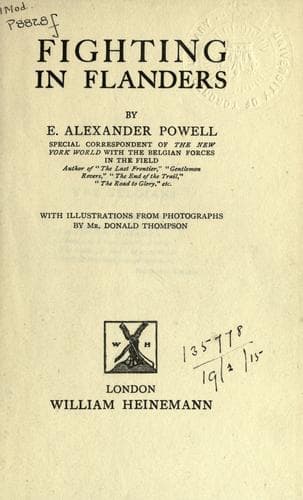
Fighting in FlandersPowell, E. Alexander (Edward Alexander)
History
Fighting in Flanders
Powell, E. Alexander (Edward Alexander)
World War, 1914-1918 -- Campaigns -- Belgium
"I am the American Consul!" he shouted. "These men are under my
protection! You are civilians, attacking German soldiers in uniform.
If they are harmed your city will be burned about your ears."
At that moment a burly Belgian shouldered his way through the
crowd and, leaping on the running-board, levelled a revolver at the
Germans cowering in the tonneau. Quick as thought Thompson
knocked up the man's hand, and at the same instant I threw on the
power. The big car leaped forward and the mob scattered before it.
It was a close call for every one concerned, but a much closer call
for Ghent; for had those German soldiers been murdered by
civilians in the city streets no power on earth could have saved the
city from German vengeance. General von Boehn told me so
himself.
A few minutes later, as playlets follow each other in quick
succession on a stage, the scene changed from near tragedy to
screaming farce. As we came thundering into the little town of
Sotteghem, which is the Sleepy Hollow of Belgium, we saw, rising
from the middle of the town square, a pyramid, at least ten feet high,
of wardrobe-trunks, steamer-trunks, bags, and suit-cases. From the
summit of this extraordinary monument floated a huge American
flag. As our car came to a halt there rose a chorus of exclamations
in all the dialects between Maine and California, and from the door
of a near-by cafe came pouring a flood of Americans. They proved
to be a lost detachment of that great army of tourists which, at the
beginning of hostilities, started on its mad retreat for the coast,
leaving Europe strewn with their belongings. This particular
detachment had been cut off in Brussels by the tide of German
invasion, and, as food-supplies were running short, they determined
to make a dash--perhaps crawl would be a better word--for Ostend,
making the journey in two lumbering farm wagons. On reaching
Sotteghem, however, the Belgian drivers, hearing that the Germans
were approaching, refused to go further and unceremoniously
dumped their passengers in the town square. When we arrived they
had been there for a day and a night and had begun to think that it
was to be their future home. It was what might be termed a mixed
assemblage, including several women of wealth and fashion who
had been motoring on the Continent and had had their cars taken
from them, two prim schoolteachers from Brooklyn, a mine-owner
from West Virginia, a Pennsylvania Quaker, and a quartet of
professional tango-dancers--artists, they called themselves--who
had been doing a "turn" at a Brussels music-hall when the war
suddenly ended their engagement. Van Hee and I skirmished about
and, after much argument, succeeded in hiring two farm-carts to
transport the fugitives to Ghent. For the thirty-mile journey the
thrifty peasants modestly demanded four hundred francs--and got it.
When I last saw my compatriots they were perched on top of their
luggage piled high on two creaking carts, rumbling down the road to
Public-domain text, read in full here on John Shaqi.
Reviews
Reviews
No reviews yet
Be the first to share your thoughts on this work.
Join the Discussion
Join the discussion
Sign in to leave a comment or review.
Sign InorCreate an account