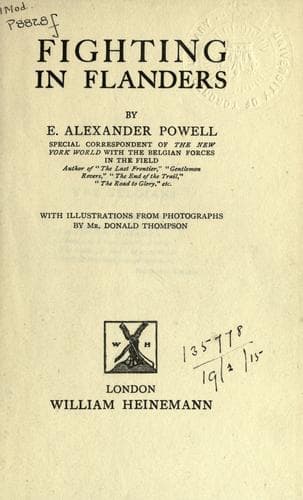
Fighting in FlandersPowell, E. Alexander (Edward Alexander)
History
Fighting in Flanders
Powell, E. Alexander (Edward Alexander)
World War, 1914-1918 -- Campaigns -- Belgium
The carabineers, for example, wore uniforms of bottle-green and
queer sugar-loaf hats of patent leather which resembled the
headgear of the Directoire period. Both the grenadiers and the
infantry of the line marched and fought and slept in uniforms of
heavy blue cloth piped with scarlet and small, round, visorless
fatigue-caps which afforded no protection from either sun or rain.
Some of the men remedied this by fitting their caps with green
reading-shades, such as undergraduates wear when they are
cramming for examinations, so that at first glance a regiment looked
as though its ranks were filled with either jockeys or students. The
gendarmes--who, by the way, were always to be found where the
fighting was hottest--were the most unsuitably uniformed of all, for
the blue coats and silver aiguillettes and towering bearskins which
served to impress the simple country-folk made splendid targets for
the German marksmen. This medley of picturesque and brilliant
uniforms was wonderfully effective, of course, and whenever I came
upon a group of lancers in sky-blue and yellow lounging about the
door of a wayside tavern or met a patrol of guides in their green
jackets and scarlet breeches trotting along a country-road, I always
had the feeling that I was looking at a painting by Meissonier or
Detaille.
At the beginning of the war the Belgian cavalry was as well mounted
as that of any European army, many of the officers having Irish
hunters, while the men were mounted on Hungarian-bred stock. The
almost incessant campaigning, combined with lack of proper food
and care, had its effect upon the horses, however, and before the
campaign in Flanders was half over the cavalry mounts were a raw-
boned and sorry-looking lot. The Belgian field artillery was horsed
magnificently: the sturdy, hardy animals native to Luxembourg and
the Ardennes making admirable material for gun-teams, while the
great Belgian draught-horses could scarcely have been improved
upon for the army's heavier work.
Public-domain text, read in full here on John Shaqi.
Reviews
Reviews
No reviews yet
Be the first to share your thoughts on this work.
Join the Discussion
Join the discussion
Sign in to leave a comment or review.
Sign InorCreate an account