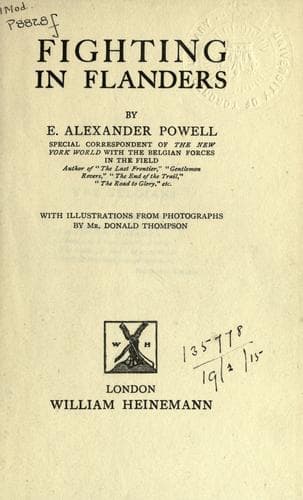
Fighting in FlandersPowell, E. Alexander (Edward Alexander)
History
Fighting in Flanders
Powell, E. Alexander (Edward Alexander)
World War, 1914-1918 -- Campaigns -- Belgium
The civilians who were wandering, foot-loose and free, about
the theatre of operations were by no means confined to the
representatives of the Press; there was an amazing number of
young Englishmen and Americans who described themselves as
"attaches" and "consular couriers" and "diplomatic messengers,"
and who intimated that they were engaged in all sorts of dangerous
and important missions. Many of these were adventurous young
men of means who had "come over to see the fun" and who had
induced the American diplomatic representatives in London and
The Hague to give them dispatches of more or less importance--
usually less than more--to carry through to Antwerp and Brussels. In
at least one instance the official envelopes with the big red seals
which they so ostentatiously displayed contained nothing but sheets
of blank paper. Their sole motive was in nearly all cases curiosity.
They had no more business wandering about the war-zone than
they would have had wandering about a hospital where men were
dying. Belgium was being slowly strangled; her villages had been
burned, her fields laid waste, her capital was in the hands of the
enemy, her people were battling for their national existence; yet
these young men came in and demanded first-row seats, precisely
as though the war was a spectacle which was being staged for their
special benefit.
One youth, who in his busy moments practised law in Boston,
though quite frankly admitting that he was only actuated by curiosity,
was exceedingly angry with me because I declined to take him to
the firing-line. He seemed to regard the desperate battle which was
then in progress for the possession of Antwerp very much as
though it was a football game in the Harvard stadium; he seemed
to think that he had a right to see it. He said that he had come all the
way from Boston to see a battle, and when I remained firm in my
refusal to take him to the front he intimated quite plainly that I was
no gentleman and that nothing would give him greater pleasure than
to have a shell explode in my immediate vicinity.
For all its grimness, the war was productive of more than one
amusing episode. I remember a mysterious stranger who called one
morning on the American Consul at Ostend to ask for assistance in
getting through to Brussels. When the Consul asked him to be
seated he bowed stiffly and declined, and when a seat was again
urged upon him he explained, in a hoarse whisper, that sewn in his
trousers were two thousand pounds in bank-notes which he was
taking through to Brussels for the relief of stranded English and
Americans--hence he couldn't very well sit down.
Public-domain text, read in full here on John Shaqi.
Reviews
Reviews
No reviews yet
Be the first to share your thoughts on this work.
Join the Discussion
Join the discussion
Sign in to leave a comment or review.
Sign InorCreate an account