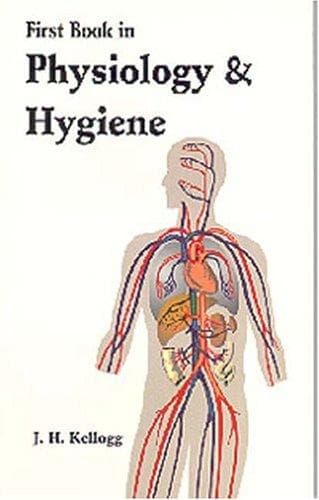
First Book in Physiology and HygieneKellogg, John Harvey
General
First Book in Physiology and Hygiene
Kellogg, John Harvey
Health -- Juvenile literature; Human physiology -- Juvenile literature; Hygiene -- Juvenile literature
~8. The Salivary~ (sal'-i-vary)~ Glands.~--There are three pairs of
_salivary glands_. They form a fluid called the _saliva_ (sa-li'-va). It
is this fluid which moistens the mouth at all times. When we eat or
taste something which we like, the salivary glands make so much saliva
that we sometimes say the mouth waters. One pair of the salivary glands
is at the back part of the lower jaw, in front of the ears. The other
two pairs of glands are placed at the under side of the mouth. The
saliva produced by the salivary glands is sent into the mouth through
little tubes called _ducts_.
~9. The Gullet.~--At the back part of the throat begins a narrow tube,
which passes down to the stomach. This tube is about nine inches long.
It is called the _gullet_, _food-pipe_, or _oesophagus_
(e-soph'-a-gus).
~10. The Stomach.~--At the lower end of the oesophagus the digestive
tube becomes enlarged, and has a shape somewhat like a pear. This is the
_stomach_. In a full-grown person the stomach is sufficiently large to
hold about three pints. At each end of the stomach is a narrow opening
so arranged that it can be opened or tightly closed, as may be
necessary. The upper opening allows the food to pass into the stomach,
the lower one allows it to pass out into the intestines. This opening is
called the _pylorus_ (py-lo'-rus), or gate-keeper, because it closes so
as to keep the food in the stomach until it is ready to pass out.
~11.~ In the membrane which lines the stomach there are many little
pocket-like glands, in which a fluid called the _gastric juice_ is
formed. This fluid is one of the most important of all the fluids formed
in the digestive canal.
[Illustration: GASTRIC GLAND.]
~12. The Intestine~(in-tes'-tine).--At the lower end of the stomach
the digestive canal becomes narrow again. This narrow portion, called
the _intestine_, is about twenty-five feet long in a grown person. The
last few feet of the intestine is larger than the rest, and is called
the _colon_. This long tube is coiled up and snugly packed away in the
cavity of the abdomen. In the membrane lining the intestines are to be
found little glands, which make a fluid called _intestinal juice_.
~13. The Liver.~--Close up under the ribs, on the right side of the
body, is a large chocolate-colored organ, called the _liver_. The liver
is about half as large as the head, and is shaped so as to fit snugly
into its corner of the abdomen. The chief business of the liver is to
make a fluid called _bile_, which is very necessary for the digestion of
our food.
~14.~ The bile is a bitter fluid of a golden-brown color. It is carried
to the intestine by means of a little tube or duct, which enters the
small intestine a few inches below the stomach. When the bile is made
faster than it is needed for immediate use, it is stored up in a little
pear-shaped sac called the _gall-bladder_, which hangs from the under
side of the liver.
Public-domain text, read in full here on John Shaqi.
Reviews
Reviews
No reviews yet
Be the first to share your thoughts on this work.
Join the Discussion
Join the discussion
Sign in to leave a comment or review.
Sign InorCreate an account