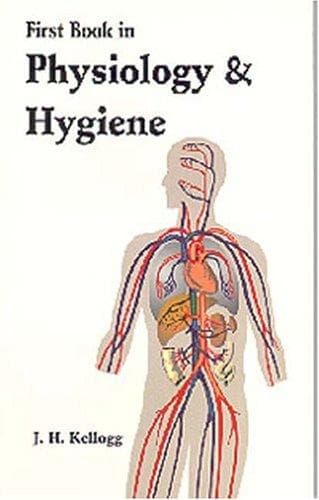
First Book in Physiology and HygieneKellogg, John Harvey
General
First Book in Physiology and Hygiene
Kellogg, John Harvey
Health -- Juvenile literature; Human physiology -- Juvenile literature; Hygiene -- Juvenile literature
~3. The Body is Like a House.~--Each of us has a house of his own which
is far more wonderful and more curious than the grandest palace ever
built. It is not a very large house. It has just room enough in it for
one person. This house, which belongs to each one of us, is called the
body.
~4. What is a Machine?~--Do you know what a machine is? Men make
machines to help them work and to do many useful things. A wheelbarrow
or a wagon is a machine to carry loads. A sewing-machine helps to make
garments for us to wear. Clocks and watches are machines for keeping
time.
~5. A Machine has Different Parts.~--A wheelbarrow has a box in which to
carry things, two handles to hold by, and a wheel for rolling it along.
Some machines, like wheelbarrows and wagons, have but few parts, and it
is very easy for us to learn how they work. But there are other
machines, like watches and sewing-machines, which have many different
parts, and it is more difficult to learn all about them and what they
do.
~6. The Body is Like a Machine.~--In some ways the body is more like a
machine than like a house. It has many different parts which are made
to do a great many different kinds of work. We see with our eyes, hear
with our ears, walk with our legs and feet, and do a great many things
with our hands. If you have ever seen the inside of a watch or a clock
you know how many curious little wheels it has. And yet a watch or a
clock can do but one thing, and that is to tell us the time of day. The
body has a great many more parts than a watch has, and for this reason
the body can do many more things than a watch can do. It is more
difficult, too, to learn about the body than about a watch.
~7.~ If we want to know all about a machine and how it works, we must
study all its different parts and learn how they are put together, and
what each part does. Then, if we want the machine to work well and to
last a long time, we must know how to use it and how to take proper care
of it. Do you think your watch would keep the time well if you should
neglect to wind it, or if you should break any of its wheels?
~8.~ It is just the same with the human machine which we call the body.
We must learn its parts, and what they are for, how they are made, how
they are put together, and how they work. Then we must learn how to take
proper care of the body, so that its parts will be able to work well
and last a long time.
~9.~ Each part of the body which is made to do some special kind of work
is called an _organ_. The eye, the ear, the nose, a hand, an arm, any
part of the body that does something, is an organ.
~10.~ The study of the various parts of the body and how they are put
together is _anatomy_ (a-nat'-o-my). The study of what each part of the
body does is _physiology_ (phys-i-ol'-o-gy). The study of how to take
care of the body is _hygiene_ (hy'-jeen).
SUMMARY.
Public-domain text, read in full here on John Shaqi.
Reviews
Reviews
No reviews yet
Be the first to share your thoughts on this work.
Join the Discussion
Join the discussion
Sign in to leave a comment or review.
Sign InorCreate an account