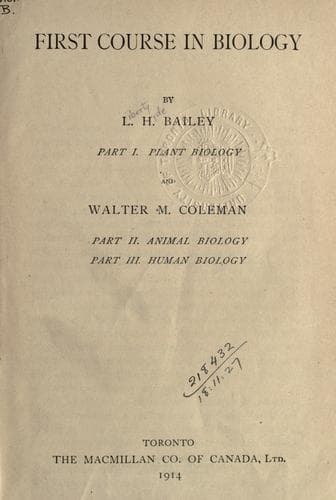
The present volume is an effort to meet the need for a simple and
untechnical text to cover this secondary biology in its elementary
phases. The book stands between the unorganized nature-study of the
intermediate grades and the formal science of the more advanced
courses. It is a difficult space to bridge, partly because the subjects
are so diverse, and partly because some teachers do not yet understand
the importance of imparting to beginners a general rather than a
special view point.
Still another difficulty is the lack of uniformity in the practice
of different schools. It is not urged that it is desirable to have
uniformity in all respects, but the lack of it makes it difficult to
prepare a book that shall equally meet all needs. It is hoped, however,
that the present book is fairly adaptable to a variety of conditions,
and with this thought in mind the following suggestions are made as to
its use:
Being in three separate parts, the teacher may begin with plants, or
with animals, or with human physiology.
If a one-year course is desired, the topics that are printed in large
type in Parts II and III may be used, and a choice from the chapters in
Part I.
For three half-year courses, all the parts may be covered in full.
If the course in biology begins in the fall (with the school year),
it may be well to study plant biology two days in the week and animal
biology three days until midwinter; when outdoor material becomes
scarce, human biology may be followed five days in the week; in spring,
plants may be studied three days and animals two days.
If the use of the book is begun at midyear, it will probably be better
to follow the order in the book consecutively.
If it is desired to take only a part of the plant biology, Chapters VI,
XIV, XX, XXIII, XXIV may be omitted, and also perhaps parts of other
chapters (as of X, XII, XIII) if the time is very short. The important
point is to give the pupil a rational conception of what plants are
and of their main activities; therefore, the parts that deal with
the underlying life processes and the relation of the plant to its
surroundings should not be omitted.
If more work is wanted it is best to provide the extra work by means
of the study of a greater abundance of specimens rather than by
the addition of more texts; but the teacher must be careful not to
introduce too much detail until the general subject has first been
covered.
The value of biology study lies in the work with the actual things
themselves. It is not possible to provide specimens for every point in
the work, nor is it always desirable to do so; for the beginning pupil
may not be able to interest himself in the objects, and he may become
immersed in details before he has arrived at any general view or reason
of the subject. Great care must be exercised that the pupil is not
swamped. Mere book work or memory stuffing is useless, and it may dwarf
or divert the sympathies of active young minds.
Public-domain text, read in full here on John Shaqi.
Reviews
Reviews
No reviews yet
Be the first to share your thoughts on this work.
Join the Discussion
Join the discussion
Sign in to leave a comment or review.
Sign InorCreate an account