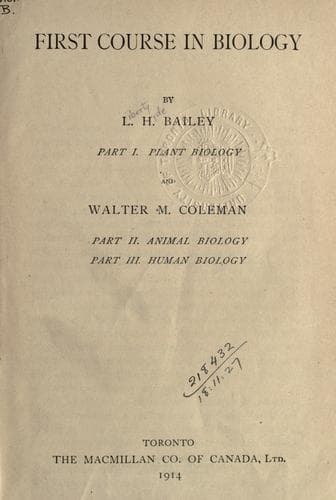
XXIV. STUDIES IN CRYPTOGAMS P 182
PART II. ANIMAL BIOLOGY
I. INTRODUCTION A 1
II. PROTOZOANS A 10
III. SPONGES A 17
IV. POLYPS A 22
V. ECHINODERMS A 34
VI. WORMS A 42
VII. CRUSTACEANS A 51
VIII. INSECTS A 63
IX. MOLLUSKS A 97
X. FISHES A 109
XI. BATRACHIANS A 126
XII. REPTILES A 139
XIII. BIRDS A 150
XIV. MAMMALS A 184
PART III. HUMAN BIOLOGY
I. INTRODUCTION H 1
II. THE SKIN AND KIDNEYS H 16
III. THE SKELETON H 28
IV. THE MUSCLES H 39
V. THE CIRCULATION H 51
VI. THE RESPIRATION H 70
VII. FOOD AND DIGESTION H 89
VIII. THE NERVOUS SYSTEM H 117
IX. THE SENSES H 142
X. BACTERIA AND SANITATION H 158
GENERAL INDEX i
GENERAL INTRODUCTION
=PRELIMINARY EXPERIMENTS=
These experiments are inserted for those pupils who have not had
instruction in chemistry and physics, to give them a point of view on
the subjects that follow. At least a general understanding of some
of these subjects is necessary to a satisfactory elementary study of
biology.
=Elements and Compounds.=--The material world is made up of elements
and compounds. An _element_ is a substance that cannot be separated
into two or more substances. A _compound_ is formed by the union of two
or more elements. All the material or substance of which the earth and
its inhabitants is composed is formed of the chemical elements; this
substance taken all together is known as _matter_.
Public-domain text, read in full here on John Shaqi.
Reviews
Reviews
No reviews yet
Be the first to share your thoughts on this work.
Join the Discussion
Join the discussion
Sign in to leave a comment or review.
Sign InorCreate an account