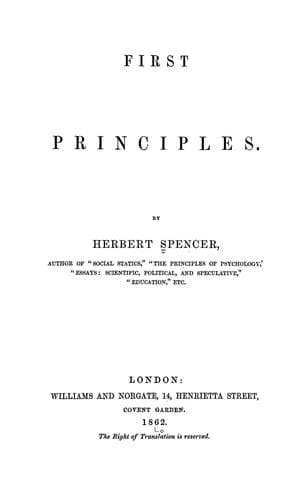
Evolution; Knowledge, Theory of; Philosophy and religion
It remains to point out that in the assemblage of organisms
constituting a species, the principle enunciated is equally traceable.
We have abundant materials for the induction that each species will
not remain uniform, but is ever becoming to some extent multiform; and
there is ground for the deduction that this lapse from homogeneity to
heterogeneity is caused by the subjection of its members to unlike
sets of circumstances. The fact that in every species, animal and
vegetal, the individuals are never quite alike; joined with the fact
that there is in every species a tendency to the production of
differences marked enough to constitute varieties; form a sufficiently
wide basis for the induction. While the deduction is confirmed by the
familiar experience that varieties are most numerous and decided
where, as among cultivated plants and domestic animals, the conditions
of life depart from the original ones, most widely and in the most
numerous ways. Whether we regard “natural selection” as wholly, or
only in part, the agency through which varieties are established,
matters not to the general conclusion. For as the survival of any
variety proves its constitution to be in harmony with a certain
aggregate of surrounding forces—as the multiplication of a variety and
the usurpation by it of an area previously occupied by some other part
of the species, implies different effects produced by such aggregate
of forces on the two, it is clear that this aggregate of forces is the
real cause of the differentiation—it is clear that if the variety
supplants the original species in some localities but not in others,
it does so because the aggregate of forces in the one locality is
unlike that in the other—it is clear that the lapse of the species
from a state of homogeneity to a state of heterogeneity arises from
the exposure of its different parts to different aggregates of forces.
* * * * *
Public-domain text, read in full here on John Shaqi.
Reviews
Reviews
No reviews yet
Be the first to share your thoughts on this work.
Elsewhere in the archive
Join the Discussion
Join the discussion
Sign in to leave a comment or review.
Sign InorCreate an account