Produced by David Garcia, David Newman, Juliet Sutherland,
Lisa Reigel, and the Online Distributed Proofreading Team
at http://www.pgdp.net
Transcriber's Notes: Greek words, Hebrew words, and some characters
may not display properly--in that case, try another version.
Transliterations of Greek and Hebrew words can be found in the ascii and
html files.
Words surrounded by _underscores_ are in italics in the original.
Characters superscripted in the original are enclosed in {braces}.
Ellipses match the original. A row of asterisks represents a thought
break.
Variations in spelling and hyphenation have been left as in the
original. Some typographical and punctuation errors have been corrected.
A complete list follows the text.
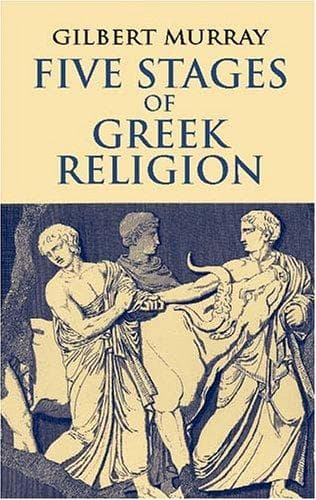
FIVE STAGES OF
GREEK RELIGION
BY
GILBERT MURRAY
Boston
THE BEACON PRESS
PREFACE TO THE THIRD EDITION
Anyone who has been in Greece at Easter time, especially among the more
remote peasants, must have been struck by the emotion of suspense and
excitement with which they wait for the announcement "_Christos
anestê_," "Christ is risen!" and the response "_Alêthôs anestê_," "He
has really risen!" I have referred elsewhere to Mr. Lawson's old peasant
woman, who explained her anxiety: "If Christ does not rise tomorrow we
shall have no harvest this year" (_Modern Greek Folklore_, p. 573). We
are evidently in the presence of an emotion and a fear which, beneath
its Christian colouring and, so to speak, transfiguration, is in its
essence, like most of man's deepest emotions, a relic from a very remote
pre-Christian past. Every spring was to primitive man a time of terrible
anxiety. His store of food was near its end. Would the dead world
revive, or would it not? The Old Year was dead; would the New Year, the
Young King, born afresh of Sky and Earth, come in the Old King's place
and bring with him the new growth and the hope of life?
I hardly realized, when writing the earlier editions of this book, how
central, how omnipresent, this complex of ideas was in ancient Greek
religion. Attis, Adonis, Osiris, Dionysus, and the rest of the "Year
Gods" were not eccentric divagations in a religion whose proper worship
was given to the immortal Olympians; they are different names given in
different circumstances to this one being who dies and is born again
each year, dies old and polluted with past deaths and sins, and is
reborn young and purified. I have tried to trace this line of tradition
in an article for the _Journal of Hellenic Studies_ for June 1951, and
to show, incidentally, how many of the elements in the Christian
tradition it has provided, especially those elements which are utterly
alien from Hebrew monotheism and must, indeed, have shocked every
orthodox Jew.
Public-domain text, read in full here on John Shaqi.
Reviews
Reviews
No reviews yet
Be the first to share your thoughts on this work.
Join the Discussion
Join the discussion
Sign in to leave a comment or review.
Sign InorCreate an account