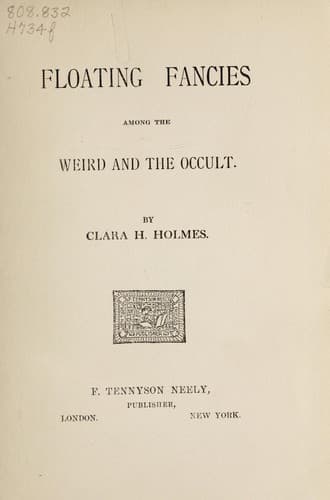
Floating Fancies among the Weird and the OccultHolmes, Clara H.
Science
Floating Fancies among the Weird and the Occult
Holmes, Clara H.
American fiction -- 19th century; Paranormal fiction; Short stories, American
He resumed precisely his former position; he made just the same vague,
intangible allusions, without one word upon which to place a hope
securely. Merna seemed plastic in his hands—and what was there to
resist, or to resent? Nothing—perhaps; yet Merna lost her healthful
calm, and grew restless and irritable; one cannot successfully resist
the intangible, or do battle with the wind. His alternate tenderness,
and good-natured indifference filled her with restless longing; she
wished that he would be more explicit, or go away and leave her alone;
she thought resentfully that it was unjust that because of her sex she
must utter no word to further her own happiness; and because custom
ordered it, she must take the crumbs offered to her, or go altogether
hungry; she must have no voice in shaping her future beyond an assent or
denial. Oh, yes; to be sure! There are a thousand ways in which a woman
may signify her preference, but it would be very shocking if she should
put it into words, unless the man asked her to do so! It looks for all
the world like putting a premium upon intrigue.
Her girlish friends exchanging confidences, rallied her about her beau:
“Oh, Merna, when are you going to be married?”
“Just as soon as I can find a man who will marry me,” retorted she, but
she flushed painfully.
“Oh don’t cheat! Tell us all about it!”
“There is nothing to tell,” replied Merna looking distressed.
A wild chorus of dissent greeted this reply; as soon as possible Merna
slipped away to cry out her grief and mortification. She thought that
every one of them was laughing at her because of her uncertainty
regarding her lover.
Ned certainly had no such feelings; he took everything for granted in a
laughing, off-hand way, not to be resisted; he came continually, he
monopolized her completely; he spoke to her, and of her as belonging to
him, but always in that laughing way which left the impression of a
joke; he did not say, such a day we will be married; such a place will
be our home; he said instead: “You belong to me; you could not get away
from me if you tried; I should find you, I shall always know where you
are.”
This was all very sweet, but—very unsatisfying. He was strong,
masterful, laughingly dominant; but he was also either very thoughtless,
or very secretive.
He made no allusion to the time of his absence except once; he had that
evening been unusually demonstrative, and Merna—from some remark made by
him—felt emboldened to ask: “Where were you while so long absent?”
“Oh, a dozen places. I can’t tell you—things get so mixed up sometimes
that I don’t know what I’m about myself,” he replied evasively.
“You might have written,” said Merna quietly, it almost seemed
indifferently.
“Yes, I know—in fact I meant to, but—I hate to write letters, and there
was nothing that you would care to know—” he broke off abruptly, as
though he did not wish to betray himself.
Public-domain text, read in full here on John Shaqi.
Reviews
Reviews
No reviews yet
Be the first to share your thoughts on this work.
Elsewhere in the archive
Join the Discussion
Join the discussion
Sign in to leave a comment or review.
Sign InorCreate an account