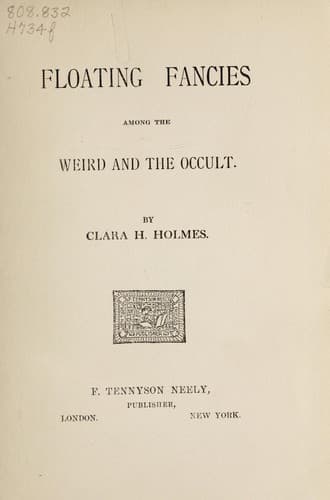
Floating Fancies among the Weird and the OccultHolmes, Clara H.
Science
Floating Fancies among the Weird and the Occult
Holmes, Clara H.
American fiction -- 19th century; Paranormal fiction; Short stories, American
“No, of course not,” answered Merna, with quiet sarcasm; she felt hurt
and indignant, but was altogether too proud to show it.
Although Merna made no further mention of it, he seemed to feel ashamed
of his neglect, and repeatedly said: “I will never leave again, without
telling you that I am going;” so that in this respect she felt a greater
assurance; but he spent the evening with her as usual, and in the usual
manner bid her good-night, and she saw him no more for three years.
Sad changes came to Merna during this interval; her mother, long a
widow, sickened and died. Merna’s grief was beyond words—beyond thought
even; it benumbed all her senses. The home which she had thought her own
was taken from her—unjustly—but what did that matter? She was alone, and
as ignorant of law as a babe. Poor child! She thought that it did not
matter, that nothing mattered, now that the gentle face of her mother
had faded out of life; she felt that she could no longer live within
those memory-haunted walls. During all these sad days she heard nothing
from Ned, and her heart cried out piteously: “Oh, if he truly loved me
he would not leave me to bear my burdens alone.” These hard realities
took away all the lingering grace of girlhood, but added the charm and
poise of sweet, self-reliant womanhood.
In these old towns, where people are born, live, and die in the same old
house, generation after generation; where the ways are peaceful and
narrow; where people drift along, content with no innovations of
knowledge, or new ways brought from the bustling, outside world, there
develops an aristocracy peculiarly its own, and those not within its
old-fashioned circle can scarcely obtain a living. Not to own the home
which their ancestors owned is looked upon as a disgrace; and owning it,
to part with it, though the misfortune is not through fault of the
owner—is considered a greater disgrace, for which there could be no
extenuation. Merna very keenly realized that she was under the ban of
social ostracism. She left this, her native place, for a town, newer and
busier, where work was to be had for such unskilled hands as hers.
Being wholly inexperienced in the ways of the world, as well as in
labor, Merna found it hard to obtain the means of subsistence; she was a
woman fair to look upon, and alone, therefore her path was beset with
peril; but she was able to retain her own self-respect—that most
truthful of all commendation—she was possessed of too much native
refinement to be led into the vulgarity of evil ways, or seduced from
right by fluent sophistries.
* * * * *
Public-domain text, read in full here on John Shaqi.
Reviews
Reviews
No reviews yet
Be the first to share your thoughts on this work.
Elsewhere in the archive
Join the Discussion
Join the discussion
Sign in to leave a comment or review.
Sign InorCreate an account