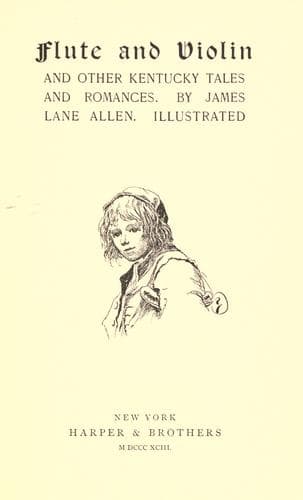
Flute and Violin, and Other Kentucky Tales and RomancesAllen, James Lane
General
Flute and Violin, and Other Kentucky Tales and Romances
Allen, James Lane
Kentucky -- Social life and customs -- Fiction; Short stories, American
"I learned that for years she had toiled and starved to hoard up a sum
with which to build a monument to his memory, for he had never failed
of his duty to her after all others had cast her out. Certainly he
had his reward, not in the monument, but in the repentance which came
to her after his death. I have never seen such sorrow for evil as the
memory of his love wrought in her. For herself she desired only that
the spot where she should be buried might be unknown. This longing to
be forgotten has led me to believe that none desire to be remembered
for the evil that is in them, but only for some truth, or beauty,
or goodness by which they have linked their individual lives to the
general life of the race. Even the lying epitaphs in cemeteries prove
how we would fain have the dead arrayed on the side of right in the
thoughts of their survivors. This wretched mother and human outcast,
believing herself to have lost everything that makes it well to be
remembered, craved only the mercy of forgetfulness."
"And yet I think she died a Christian soul."
"You knew her, then?"
"I was with her in her last hours. She told me her story. She told me
also of you, and that you would accept nothing for the monument you
were at such care to make. It is perhaps for this reason that I have
felt some desire to see you, and that I am here now to speak with you
of--"
A shudder passed over her.
"After all, that was not a sad, but a joyous monument to fashion," she
added, abruptly.
"Aye, it was joyous. But to me the joyous and the sad are much allied
in the things of this life."
"And yet there might be one monument wholly sad, might there not?"
"There might be, but I know not whose it would be."
"If she you love should die, would not hers be so?"
"Until I love, and she I love is dead, I cannot know," said Nicholas,
smiling.
"What builds the most monuments?" she asked, quickly, as though to
retreat from her levity.
"Pride builds many--splendid ones. Gratitude builds some, forgiveness
some, and pity some. But faith builds more than these, though often
poor, humble ones; and love!--love builds more than all things else
together."
"And what, of all things that monuments are built in memory of, is most
loved and soonest forgotten?" she asked, with intensity.
"Nay, I cannot tell that."
"Is it not a beautiful woman? This, you say, is the monument of a poet.
After the poet grows old, men love him for the songs he sang; they love
the old soldier for the battles he fought, and the preacher for his
remembered prayers. But a woman! Who loves her for the beauty she once
possessed, or rather regards her not with the more distaste? Is there
in history a figure so lonely and despised as that of the woman who,
once the most beautiful in the world, crept back into her native land a
withered hag? Or, if a woman die while she is yet beautiful, how long
is she remembered? Her beauty is like heat and light--powerful only for
those who feel and see it."
Public-domain text, read in full here on John Shaqi.
Reviews
Reviews
No reviews yet
Be the first to share your thoughts on this work.
Elsewhere in the archive
Join the Discussion
Join the discussion
Sign in to leave a comment or review.
Sign InorCreate an account