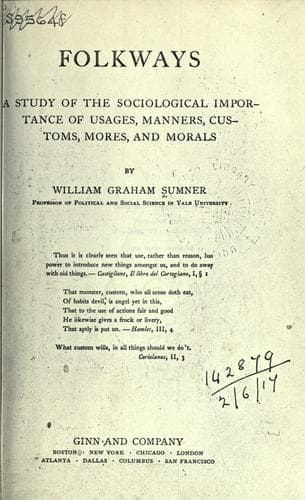
Folkways: A Study of the Sociological Importance of Usages, Manners, Customs, Mores, and MoralsSumner, William Graham
General
Folkways: A Study of the Sociological Importance of Usages, Manners, Customs, Mores, and Morals
Sumner, William Graham
Manners and customs
mode of life, it would be a very important contribution to ethnology. We
are forced to believe that, if a baby born in New England was taken to
China and given to a Chinese family to rear and educate, he would become
a Chinaman in all which belongs to the mores, that is to say, in his
character, conduct, and code of life.
+113. Antagonism of earlier and later mores.+ When, in the course of
time, changes occur in the mores, the men of a later generation find
themselves in antagonism to the mores of their ancestors. In the Homeric
poems cases are to be found of disapproval by a later generation of the
mores of a former one. The same is true of the tragedies of the fifth
century in respect to the mythology and heroism in Homer. The punishment
of Melantheus, the unfaithful goatherd, was savage in the extreme, but
when Eurykleia exulted over the dead suitors, Ulysses told her that it
was a cruel sin to rejoice over slain enemies.[143] In the _Iliad_
boastful shouts over the dead are frequent. In the _Odyssey_ such shouts
are forbidden.[144] Homer thinks that it was unseemly for Achilles to
drag the corpse of Hector behind his chariot.[145] He says that the gods
disapproved, which is the mystic way of describing a change in the
mores.[146] He also disapproves of the sacrifice of Trojan youths on the
pyre of Patroclus.[147] It was proposed to Pausanias that he should
repay on the corpse of Mardonius the insults which Xerxes had practiced
on the corpse of Leonidas at Thermopylae, but he indignantly
refused.[148] In the _Eumenides_ of AEschylus the story of Orestes is
represented as a struggle between the mores of the father family and
those of the mother family. In the _Herakleidae_ there is a struggle
between old and new mores as to the killing of captives. Many such
contrasts are drawn between Greek and barbarian mores, the latter being
old and abandoned customs which have become abominable to the Greeks
(incest, murder of strangers). In the fourth century the Greeks were so
humbled by their own base treatment of each other that this contrast
ceased to be drawn.[149] Similar contrasts between earlier and later
mores appear in the Bible. Our own mores set us in antagonism to much
which we find in the Bible (slavery, polygamy, extirpation of
aborigines). The mores always bring down in tradition a code which is
old. Infanticide, slavery, murder of the old, human sacrifices, etc.,
are in it. Later conditions force a new judgment, which is in revolt and
antagonism to what always has been done and what everybody does. Slavery
is an example of this in recent history.
Public-domain text, read in full here on John Shaqi.
Reviews
Reviews
No reviews yet
Be the first to share your thoughts on this work.
Elsewhere in the archive
Join the Discussion
Join the discussion
Sign in to leave a comment or review.
Sign InorCreate an account