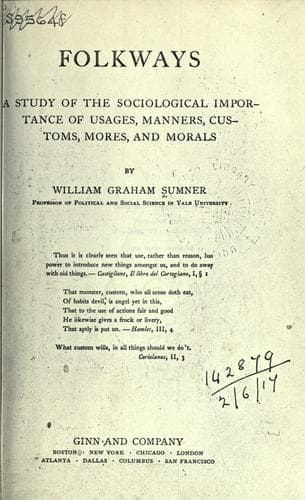
Folkways: A Study of the Sociological Importance of Usages, Manners, Customs, Mores, and MoralsSumner, William Graham
General
Folkways: A Study of the Sociological Importance of Usages, Manners, Customs, Mores, and Morals
Sumner, William Graham
Manners and customs
+110. Sparta.+ The case of Sparta is especially interesting because the
Spartan mores were generally admired and envied in the fourth century
B.C. They were very artificial and arbitrary. They developed into a
catastrophe. The population declined to such a point that it was like
group suicide. The nation incased itself in fossilized mores and
extremest conservatism, by which its own energies were crushed. The
institutions produced consequences which were grotesque compared with
what had been expected from them.[141]
+111. Optimism of prosperity.+ "I apprehend that the key to the joyful
character of the antique religions known to us [in western Asia] lies in
the fact that they took their shape in communities that were progressive
and, on the whole, prosperous." Weak groups were exterminated. Those
which survived "had all the self-confidence and elasticity that are
engendered by success in the struggle of life." "The religious gladness
of the Semites tended to assume an orgiastic character and become a sort
of intoxication of the senses, in which anxiety and sorrow were drowned
for the moment."[142]
+112. Antagonism between an individual and the mores.+ The case of
dissent from the mores, which was considered above (sec. 100), is the
case in which the individual voluntarily sets himself in antagonism to
the mores of the society. There are cases in which the individual finds
himself in involuntary antagonism to the mores of the society, or of
some subgroup to which he belongs. If a man passes from one class to
another, his acts show the contrast between the mores in which he was
bred and those in which he finds himself. The satirists have made fun of
the _parvenu_ for centuries. His mistakes and misfortunes reveal the
nature of the mores, their power over the individual, their pertinacity
against later influences, the confusion in character produced by
changing them, and the grip of habit which appears both in the
persistence of old mores and the weakness of new ones. Every emigrant is
forced to change his mores. He loses the sustaining help of use and
wont. He has to acquire a new outfit of it. The traveler also
experiences the change from life in one set of mores to life in another.
The experience gives him the best power to criticise his native mores
from a standpoint outside of them. In the North American colonies white
children were often stolen by Indians and brought up by them in their
ways. Whether they would later, if opportunity offered, return to white
society and white mores, or would prefer to remain with the Indians,
seems to have depended on the age at which they were captured.
Missionaries have often taken men of low civilization out of the society
in which they were born, have educated them, and taught them white men's
mores. If a single clear and indisputable case could be adduced in which
such a person was restored to his own people and did not revert to their
Public-domain text, read in full here on John Shaqi.
Reviews
Reviews
No reviews yet
Be the first to share your thoughts on this work.
Elsewhere in the archive
Join the Discussion
Join the discussion
Sign in to leave a comment or review.
Sign InorCreate an account