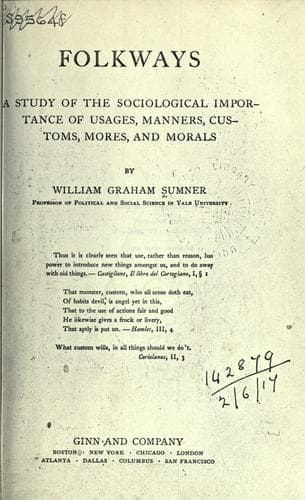
Folkways: A Study of the Sociological Importance of Usages, Manners, Customs, Mores, and MoralsSumner, William Graham
General
Folkways: A Study of the Sociological Importance of Usages, Manners, Customs, Mores, and Morals
Sumner, William Graham
Manners and customs
+6. The aleatory interest.+ If we should try to find a specimen society
in which expedient ways of satisfying needs and interests were found by
trial and failure, and by long selection from experience, as broadly
described in sec. 1 above, it might be impossible to find one. Such a
practical and utilitarian mode of procedure, even when mixed with ghost
sanction, is rationalistic. It would not be suited to the ways and
temper of primitive men. There was an element in the most elementary
experience which was irrational and defied all expedient methods. One
might use the best known means with the greatest care, yet fail of the
result. On the other hand, one might get a great result with no effort
at all. One might also incur a calamity without any fault of his own.
This was the aleatory element in life, the element of risk and loss,
good or bad fortune. This element is never absent from the affairs of
men. It has greatly influenced their life philosophy and policy. On one
side, good luck may mean something for nothing, the extreme case of
prosperity and felicity. On the other side, ill luck may mean failure,
loss, calamity, and disappointment, in spite of the most earnest and
well-planned endeavor. The minds of men always dwell more on bad luck.
They accept ordinary prosperity as a matter of course. Misfortunes
arrest their attention and remain in their memory.
Hence the ills of life are the mode of manifestation of the aleatory
element which has most affected life policy. Primitive men ascribed all
incidents to the agency of men or of ghosts and spirits. Good and ill
luck were attributed to the superior powers, and were supposed to be due
to their pleasure or displeasure at the conduct of men. This group of
notions constitutes goblinism. It furnishes a complete world philosophy.
The element of luck is always present in the struggle for existence.
That is why primitive men never could carry on the struggle for
existence, disregarding the aleatory element and employing a utilitarian
method only. The aleatory element has always been the connecting link
between the struggle for existence and religion. It was only by
religious rites that the aleatory element in the struggle for existence
could be controlled. The notions of ghosts, demons, another world, etc.,
were all fantastic. They lacked all connection with facts, and were
arbitrary constructions put upon experience. They were poetic and
developed by poetic construction and imaginative deduction. The nexus
between them and events was not cause and effect, but magic. They
therefore led to delusive deductions in regard to life and its meaning,
which entered into subsequent action as guiding faiths, and imperative
notions about the conditions of success. The authority of religion and
that of custom coalesced into one indivisible obligation. Therefore the
simple statement of experiment and expediency in the first paragraph
above is not derived directly from actual cases, but is a product of
Public-domain text, read in full here on John Shaqi.
Reviews
Reviews
No reviews yet
Be the first to share your thoughts on this work.
Join the Discussion
Join the discussion
Sign in to leave a comment or review.
Sign InorCreate an account