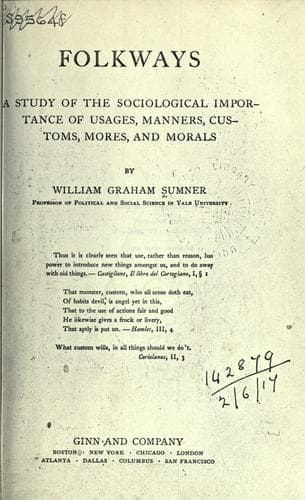
Folkways: A Study of the Sociological Importance of Usages, Manners, Customs, Mores, and MoralsSumner, William Graham
General
Folkways: A Study of the Sociological Importance of Usages, Manners, Customs, Mores, and Morals
Sumner, William Graham
Manners and customs
for Christian in western Europe are the result of the syncretism of two
thousand years. When now western Christians come in contact with
heathen, Mohammedans, Buddhists, or alien forms of Christianity, they
endeavor to put an end to polygamy, slavery, infanticide, idolatry,
etc., which have been extruded from western Christian mores. In Egypt at
the present time the political power and economic prosperity of the
English causes the Mohammedans to envy, emulate, and imitate them in all
those peculiarities which are supposed to be causes of their success.
Hence we hear of movements to educate children, change the status of
women, and otherwise modify traditional mores. It is another case of the
operation by which inferior mores are rendered obsolete.
+121. The art of societal administration.+ It is not to be inferred that
reform and correction are hopeless. Inasmuch as the mores are a
phenomenon of the society and not of the state, and inasmuch as the
machinery of administration belongs to the state and not to the society,
the administration of the mores presents peculiar difficulties. Strictly
speaking, there is no administration of the mores, or it is left to
voluntary organs acting by moral suasion. The state administration fails
if it tries to deal with the mores, because it goes out of its province.
The voluntary organs which try to administer the mores (literature,
moral teachers, schools, churches, etc.) have no set method and no
persistent effort. They very often make great errors in their methods.
In regard to divorce, for instance, it is idle to set up stringent rules
in an ecclesiastical body, and to try to establish them by extravagant
and false interpretation of the Bible, hoping in that way to lead
opinion; but the observation and consideration of cases which occur
affect opinion and form convictions. The statesman and social
philosopher can act with such influences, sum up the forces which make
them, and greatly help the result. The inference is that intelligent art
can be introduced here as elsewhere, but that it is necessary to
understand the mores and to be able to discern the elements in them,
just as it is always necessary for good art to understand the facts of
nature with which it will have to deal. It belongs to the work of
publicists and statesmen to gauge the forces in the mores and to
perceive their tendencies. The great men of a great epoch are those who
have understood new currents in the mores. The great reformers of the
sixteenth century, the great leaders of modern revolutions, were, as we
can easily see, produced out of a protest or revulsion which had long
been forming under and within the existing system. The leaders are such
because they voice the convictions which have become established and
because they propose measures which will realize interests of which the
society has become conscious. A hero is not needed. Often a mediocre,
commonplace man suffices to give the critical turn to thought or
interest.
Public-domain text, read in full here on John Shaqi.
Reviews
Reviews
No reviews yet
Be the first to share your thoughts on this work.
Elsewhere in the archive
Join the Discussion
Join the discussion
Sign in to leave a comment or review.
Sign InorCreate an account