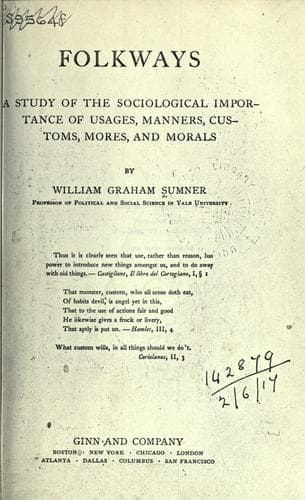
Folkways: A Study of the Sociological Importance of Usages, Manners, Customs, Mores, and MoralsSumner, William Graham
General
Folkways: A Study of the Sociological Importance of Usages, Manners, Customs, Mores, and Morals
Sumner, William Graham
Manners and customs
"A Gian Angelo Medici, agreeable, diplomatic, benevolent, and
pleasure-loving, sufficed to initiate a series of events which kept the
occidental races in perturbation through two centuries."[163] Great
crises come when great new forces are at work changing fundamental
conditions, while powerful institutions and traditions still hold old
systems intact. The fifteenth century was such a period. It is in such
crises that great men find their opportunity. The man and the age react
on each other. The measures of policy which are adopted and upon which
energy is expended become components in the evolution. The evolution,
although it has the character of a nature process, always must issue by
and through men whose passions, follies, and wills are a part of it but
are also always dominated by it. The interaction defies our analysis,
but it does not discourage our reason and conscience from their play on
the situation, if we are content to know that their function must be
humble. Stoll boldly declares that if one of us had been a judge in the
times of the witch trials he would have reasoned as the witch judges
did, and would have tortured like them.[164] If that is so, then it
behooves us by education and will, with intelligent purpose, to
criticise and judge even the most established ways of our time, and to
put courage and labor into resistance to the current mores where we
judge them wrong. It would be a mighty achievement of the science of
society if it could lead up to an art of societal administration which
should be intelligent, effective, and scientific.
[90] _N. S. Amer. Anthrop._, IV, 3.
[91] _Globus_, LXXXVII, 130.
[92] "Religion of Israel," Hastings, _Dict._, Supp. vol.
[93] Tiele, _Relig. in Alterthum_, I, 295.
[94] _Ibid._, 242.
[95] Stammler, _Stellung der Frauen_, 3.
[96] Friedberg, _Recht der Eheschliessung_.
[97] _Ztsft. f. Volkskunde_, XI, 272.
[98] Scherr, _Deutsche Kultur-und Sittengesch._, 171.
[99] Stammler, _Stellung der Frauen_, 8.
[100] Wachsmuth, _Bauernkriege_, in Raumer, _Taschenbuch_, V.
[101] _Charters_, 449.
[102] Stubbs, _History_, II, 453.
[103] _Stellung der Frauen_, 3.
[104] Sec. 86.
[105] Hiekisch, _Tungusen_, 31; Sieroshevski, _Yakuty_, I, 415.
[106] Simkhovitsch, _Feldgemeinschaft in Russland_, Chap. XXIX.
[107] _Japan and the Japanese_, 360.
[108] _Vererbung und Auslese_, 282.
[109] _Pol. Anth. Revue_, III, 416.
[110] Brandt in _Umschau_, VIII, 722.
[111] Hearn, _Japan_, 193.
[112] _Ibid._, 112. Cf. sec. 76.
[113] _Web of Indian Life_, 125.
[114] _Brahmanism and Hinduism_, 352.
[115] Mayer, _Oesterreich_, II, 454-465.
[116] Gauthiez, _Lorenzaccio_, 230.
[117] _Ibid._, 227.
[118] _Japan_, 20.
[119] Harnack, _Dogmengesch._ (3rd ed.), I, 319.
[120] Van Duyl, _Beschavingsgeschiedenis van het Nederl. Volk_,
237.
[121] _De Anima_, 30.
[122] Boissier, _Relig. Rom._, I, 239.
Public-domain text, read in full here on John Shaqi.
Reviews
Reviews
No reviews yet
Be the first to share your thoughts on this work.
Elsewhere in the archive
Join the Discussion
Join the discussion
Sign in to leave a comment or review.
Sign InorCreate an account