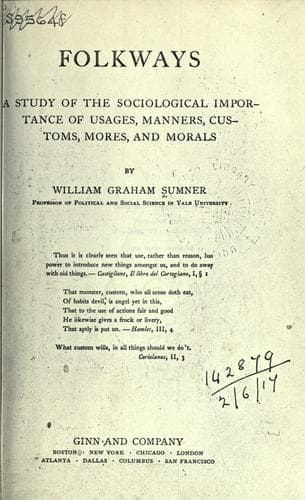
Folkways: A Study of the Sociological Importance of Usages, Manners, Customs, Mores, and MoralsSumner, William Graham
General
Folkways: A Study of the Sociological Importance of Usages, Manners, Customs, Mores, and Morals
Sumner, William Graham
Manners and customs
Indians, although they lived on the product of the ground, were obliged
to continue the chase because of the materials and implements which they
got from the animals. They used the jaw of a fish, with the teeth in it,
as a knife; the arm and leg bones of apes as arrow points; the tail
spike of a skate for the same; the two front claws of the armadillo to
dig the ground (a process which the animal taught them by the same use
of his claws); the shell of a river mussel as a scraper to finish wooden
tools. "These people were hunters without dogs, fishers without hooks,
and tillers without plow or spade. They show how much development life
was capable of in the time before metals."[170] The palometa is a fish
which weighs two or three pounds. It has fourteen teeth in each jaw so
sharp that the Abipones shear sheep with the jaw.[171] Such cases might
be pursued into great detail. They show acute observation, great
ingenuity, clever adaptation, and teachableness. The lasso, bola,
boomerang, and throw knife, as well as the throw stick, are products of
persistent and open-minded experience. The selection and adaptation of
things in nature to a special operation in the arts often show ingenuity
as great as that manifested in any of our devices.[172] This ingenuity
is of the same kind as that shown by many animals. Intelligent
experiment, however, is not wanting. It is reported of Eskimo that they
invent imaginary hard cases, such as might occur to them, and, by way of
sport, discuss the proper way to deal with the case.[173] Operations
similar to this in play show a mode in which ingenuity must have been
developed and inventions produced. In the higher grades of the hunting
stage, such as are presented by the North American Indians, buffalo
hunting, for instance, calls for the highest organization and skill, and
establishes inflexible discipline.[174]
Public-domain text, read in full here on John Shaqi.
Reviews
Reviews
No reviews yet
Be the first to share your thoughts on this work.
Elsewhere in the archive
Join the Discussion
Join the discussion
Sign in to leave a comment or review.
Sign InorCreate an account