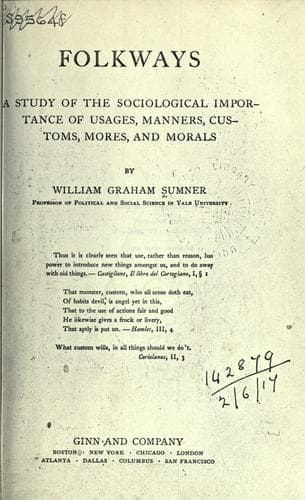
Folkways: A Study of the Sociological Importance of Usages, Manners, Customs, Mores, and MoralsSumner, William Graham
General
Folkways: A Study of the Sociological Importance of Usages, Manners, Customs, Mores, and Morals
Sumner, William Graham
Manners and customs
Processes and artifacts of the food supply.--Fishing.--Methods
of fishing.--The mystic element.--Religion and industry.--
Artifacts and freaks of nature.--Forms of stone axes.--How
stone implements are made.--How arrowheads are made.--How stone
axes are used.--Acculturation or parallelism.--Fire-making
tools.--Psychophysical traits of primitive man.--Language.--
Language and magic.--Language is a case of folkways.--Primitive
dialects.--Taking up and dropping language.--Pigeon dialects.--
How languages grow.--Money.--Intergroup and intragroup money.--
Predominant wares.--Intragroup money from property; intergroup
money from trade.--Shell and bead money.--Token money.--
Selection of a predominant ware.--Stone money in Melanesia.--
Plutocratic effects of money.--Money on the northwest coast of
North America.--Wampumpeag and roanoke.--Ring money. Use of
metal.--The evolution of money.--The ethical functions of
money.
+122. Processes and artifacts of the food supply.+ The processes and the
artifacts which are connected with food supply offer us the purest and
simplest illustrations of the development of folkways. They are not free
from the admixture of superstition and vanity, but the element of
expediency predominates in them. It is reported of the natives of New
South Wales that a man will lie on a rock with a piece of fish in his
hand, feigning sleep. A hawk or crow darts at the fish, but is caught by
the man. It is also reported of Australians that a man swims under
water, breathing through a reed, approaches ducks, pulls one under water
by the legs, wrings its neck, and so secures a number of them.[165] If
these stories can be accepted with confidence, they may well furnish us
a starting point for a study of the art of catching animals. The man
really has no tool, but must rely entirely on his own quickness and
dexterity. Birdlime is a device for which many plants furnish
material,[166] and which is available even against large game, which is
fretted and worn out by it until it becomes the prey of man. A Botocudo
hunter grates the eggs of an alligator together, when he finds them on
the bank, and so entices the mother.[167] The Yuroks of California
sprinkled berries on the shallow bottom of a river and stretched a net a
few inches below the surface of the water. Ducks diving for the berries
were caught by the neck in the meshes and drowned. As they hung quiet
they did not frighten away others.[168] The Tarahumari catch birds by
stringing corn kernels on a fiber which is buried underground. The bird
swallows the corn and cannot eject it.[169] Various animals were trained
to help man in the food quest and were thus drawn into the industrial
organization. The animals furnished materials (skin, bone, teeth, hair,
horns) and also tools, so that the food quest broadened beyond the
immediate supply of food into mechanical industrial forms. The Shingu
Public-domain text, read in full here on John Shaqi.
Reviews
Reviews
No reviews yet
Be the first to share your thoughts on this work.
Elsewhere in the archive
Join the Discussion
Join the discussion
Sign in to leave a comment or review.
Sign InorCreate an account