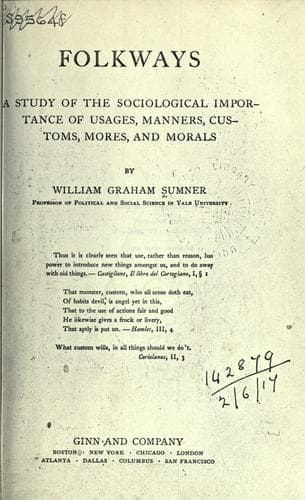
Folkways: A Study of the Sociological Importance of Usages, Manners, Customs, Mores, and MoralsSumner, William Graham
General
Folkways: A Study of the Sociological Importance of Usages, Manners, Customs, Mores, and Morals
Sumner, William Graham
Manners and customs
+126. Religion and industry.+ Here we meet with a familiar cycle of
notions and usages. We must assume them in all cases, whether they are
reported or not, for the element of supernatural intervention, or magic,
seems never to be wanting. At higher stages it gives way to religious
ritual or to priestly blessing. The Japanese sword maker formerly wore a
priestly garb when making a sword, which was a sacred craft. He also
practiced a purificatory ritual. The sacred rope of rice straw, the
oldest symbol of Shinto, was suspended before the smithy. The workman's
food was all cooked with holy fire, and none of his family might enter
the workshop or speak to him while he was at work.[188] There were also
ascetic practices in the Shinto religion, which an elected
representative of the community undertook each year for the prosperity
of the whole.[189] There is never a case of authority in human society
which does not go back, for its origin and explanation, to the influence
of the other world (ghosts, etc.) over this world.
+127. Artifacts and freaks of nature.+ In the Oxford University museum
may be seen a case full of natural stones, flints, etc., so like the
artifacts of the Chellean type that it would require a skilled observer
to determine whether they are artificial or not. The collection includes
apparent celts, rings, perforated stones, borers, scrapers, and flint
flakes, so that the objects are by no means such as would lie at the
beginning of the series of artifacts, in regard to which the doubt
whether they were artificial would arise from their rudeness and
consequent resemblance to stones broken by natural conjunctures. In the
museum at Dresden may be seen a collection of stones, natural products,
which might serve as models for artificial axes, celts, etc. One object
shows the possibility of freaks of nature of this class. It is a
water-worn stone which might be taken for a skull. In the Copenhagen
museum is a great collection of stone tools arranged in sequence of
perfection, beginning with the coarsest and rudest and advancing to the
highest products of art of this kind. That collection is arranged solely
with reference to the development of the flint and stone implements as
tools for a certain use. The sequence is very convincing as to the
interpretation put on the objects, and also as to the strain towards
improvement. Time and place are disregarded in the arrangement. The
earliest specimens in the series are very rude, and only expert opinion
could justify their place amongst artifacts. It reminds us of what we
are told about specimens of Australian "tomahawks." It is said of such a
weapon from West Australia that if it was "found anywhere divested of
the gum and handle, it is doubtful whether it could be recognized by any
one as a work of art. It is ruder in its fashioning, owing principally
to the material of which it is composed, than even the rude, unrubbed,
chipped cutting-stones of the Tasmanians."[190] With regard to these
Public-domain text, read in full here on John Shaqi.
Reviews
Reviews
No reviews yet
Be the first to share your thoughts on this work.
Elsewhere in the archive
Join the Discussion
Join the discussion
Sign in to leave a comment or review.
Sign InorCreate an account