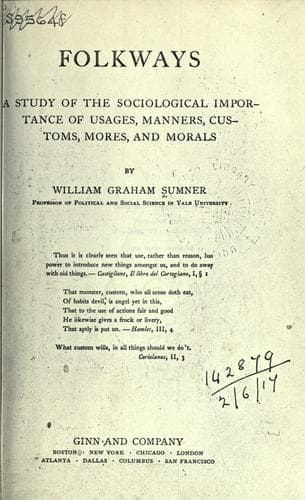
Folkways: A Study of the Sociological Importance of Usages, Manners, Customs, Mores, and MoralsSumner, William Graham
General
Folkways: A Study of the Sociological Importance of Usages, Manners, Customs, Mores, and Morals
Sumner, William Graham
Manners and customs
stone implements of the Tasmanians Tylor said that some of them are
"ruder in make than those of the mammoth period, inasmuch as their edges
are formed by chipping only one surface of the stone, instead of both,
as in the European examples." The Tasmanians, when they needed a cutting
implement, caught up a suitable flat stone, knocked off chips from one
side, partly or all around the edge, and used it without more ado. This
they did under the eyes of modern Europeans. Tylor showed, "from among
flint instruments and flakes from the cave of le Moustier in Dordogne,
specimens corresponding in make with such curious exactness to those of
the Tasmanians that, were they not chipped from different stones, it
would hardly be possible to distinguish those of recent savages from
those of European cavemen. It is not strange that experienced
archaeologists should have been at first inclined to consider a large
portion of the Tasmanian stone implements exhibited as wasters and
flakes, or chips, struck off in shaping implements." These stones had no
handle. They were grasped in the hand.[191] In the Oxford museum may be
seen side by side flint shapes from St. Acheul, Tasmania, India, and the
Cape of Good Hope: All the paleolithic implements which we possess, even
the oldest and rudest, belong far on in a series of which the antecedent
members are wanting, for the art, if recognized, is seen to be advanced
and artistic.[192] The Seri of southern California use a natural
cobblestone, which is shaped only by the wear of use, and is discarded
when sharp edges are produced by use or fracture. They use their teeth
and claws like beasts. They have not a knife-sense and need training
before they can use a knife. The stone selected is of an ovoid form
somewhat flattened. By use it is battered on the ends and ground on the
sides so that it becomes personal property and acquires fetishistic
import. It is buried with the corpse of the woman who owned and used
it.[193] Holmes, after experimenting with the manufacture of stone
implements, declared that "every implement resembling the final forms
and every blade-shaped projectile point made from a bowlder, or similar
bit of rock, not already approximate in shape, must pass through the
same or very nearly the same, stages of development, leaving the same
wasters, whether shaped to-day, yesterday, or a million years ago;
whether in the hands of the civilized, the barbarous, or the savage
man."[194] This conclusion is very important, for it recognizes a
certain constant determination of the art of stone-implement making by
the qualities of the material and the muscular activities of man. It has
been disputed whether the form called "turtle-backs" were one form in
the series of artifacts, or a misform produced by errors in manufacture.
"The American archaeologists, who have labored long to repeat the
processes of the aborigines in stone work, find themselves unavoidably
Public-domain text, read in full here on John Shaqi.
Reviews
Reviews
No reviews yet
Be the first to share your thoughts on this work.
Elsewhere in the archive
Join the Discussion
Join the discussion
Sign in to leave a comment or review.
Sign InorCreate an account