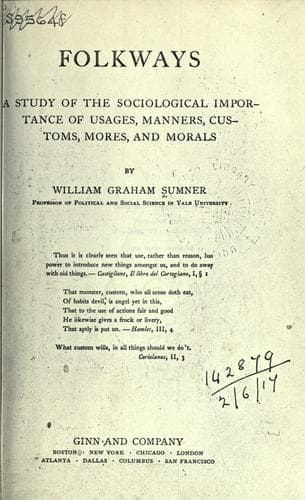
Folkways: A Study of the Sociological Importance of Usages, Manners, Customs, Mores, and MoralsSumner, William Graham
General
Folkways: A Study of the Sociological Importance of Usages, Manners, Customs, Mores, and Morals
Sumner, William Graham
Manners and customs
+129. How stone implements are made.+ What was the process by which
these stone implements were made? The artifacts bear witness directly to
two or three different operations, separate or combined, and to a great
development of the process. As above stated, Tasmanians, after they
became known to Europeans, made stone implements as they needed them,
giving to a stone a rude adaptation to the purpose by chipping off a few
flakes. Short sharp blows were struck by one stone upon another. The
blow must, however, fall upon just the right spot or it would not
produce the desired result. Therefore the flakes were often thrown off
by pressure. A stick or horn was set against the spot where the force
should be applied, and braced against the breast of the operator, while
he held the stone between his feet. This latter operation is described
as used by the Mexicans to get flakes of obsidian.[206] By carrying
further the process of chipping or pressing the stone could be shaped
more perfectly, and by rubbing it on another stone it could be given a
cutting edge. The rubbing process could also be applied to the surface
to make it smooth instead of leaving it as it was after the flaking
process. The processes of striking and pressing were also combined. The
pebble was broken by blows and the pieces were further reduced to shape
by the pressing process. Different devices were also invented for
holding the stone securely and in the proper position. Skill and
judgment in perceiving how and for what purpose each pebble could best
be treated was developed by the workers, and division of labor arose
amongst them as some acquired greater skill in one operation and others
in another. The operations of pressing and striking were also made
complex in order to accomplish what was desired. A sapling was cut off
so that the stump of a limb was left at the bottom of it. It was set
against the spot where the force was needed, and a blow struck in the
crotch of the limb caused the chip to fly. This apparatus was improved
and refined by putting a horn tip on the end point of contact. Another
device was to cut a notch in a tree trunk, which could be used as a
fulcrum. A long lever was used to apply the pressure to the stone laid
at the root of the tree, or on the horizontal space at the bottom of the
notch.[207] These variations show persistent endeavor to get control of
the necessary force and to apply it at the proper point with the least
chance for error and loss. Buckley reported about the "tomahawks" of the
aborigines of Victoria, that the stone was split into pieces, without
regard to their shape, but of convenient thickness. A piece was rubbed
on rough granite until "it is brought to a very fine thin edge, and so
hard and sharp as to enable them to fell a very large tree with it." The
handles are "thick pieces of wood, split and then doubled up, the stone
being in the bend and fixed with gum, very carefully prepared for the
Public-domain text, read in full here on John Shaqi.
Reviews
Reviews
No reviews yet
Be the first to share your thoughts on this work.
Elsewhere in the archive
Join the Discussion
Join the discussion
Sign in to leave a comment or review.
Sign InorCreate an account