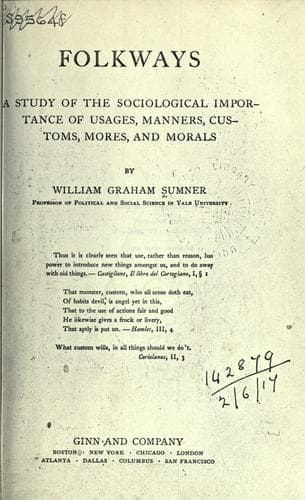
Folkways: A Study of the Sociological Importance of Usages, Manners, Customs, Mores, and MoralsSumner, William Graham
General
Folkways: A Study of the Sociological Importance of Usages, Manners, Customs, Mores, and Morals
Sumner, William Graham
Manners and customs
making 'turtle-backs,' when they are really trying to make the
leaf-shaped blade."[195] The handicraftsmen of the Smithsonian Institute
have not been able to make a leaf-shaped blade such as may be seen in
the museums, and no Indian has been found who could make one. "This is
one of the lost arts."[196] Other pieces of rude form have been set
aside as chips, or rejects, but such are found in use as scrapers, or in
handles, and are to be recognized as products which belong to the
series.[197] Some rude implements found in the hill gravels of
Berkshire, England, have been offered as anterior to the paleolithic
implements as usually classified.[198] Lubbock said that he could not
find in the large Scandinavian collections "a single specimen of a true
paleolithic type."[199]
+128. Forms of stone axes.+ Stone axes are found all over the globe.
Chipped, sharpened, polished, grooved, pierced, handled, are different
kinds which may be set in a series of advancing improvement, and under
each grade local varieties may be distinguished, but the art is
essentially the same everywhere. "Probably no discovery is older than
the fact that friction would wear away wood or bone, or even
stone."[200] It was also learned that rawhide and sinew shrank in
drying, and this fact was very ingeniously used to attach handles, the
sinew or membrane being put on while fresh and wet. American stone axes
are grooved to receive a handle made by an ingenious adaptation of roots
and branches with pitch or bitumen. "Bored stone axes are found in the
tropical regions of America. Although they are very rare, they are well
executed."[201] The device of boring stone axes appears at the end of
the stone age in the lake dwellings of Switzerland. Perhaps they were
only decorative.[202] The Polynesians used stone axes which were
polished but not bored or grooved, and the edge was not curved.[203] The
Pacific islanders clung to the type of the adze, so that even when they
got iron and steel implements from the whites they preferred the knife
of a plane to an ax, because the former could be used adze-fashion.[204]
In the stone graves of Tennessee have been found implements superior to
all others found in the United States in size, variety, and workmanship.
Amongst these are a flint sickle-shaped tool, axes a foot long or more,
a flint sword twenty-two inches long, a flint needle eight inches long;
also objects supposed to be for ceremonial or decorative use. Stone axes
with handles all in one piece have been found in Tennessee, Arkansas,
and South Carolina.[205]
Public-domain text, read in full here on John Shaqi.
Reviews
Reviews
No reviews yet
Be the first to share your thoughts on this work.
Elsewhere in the archive
Join the Discussion
Join the discussion
Sign in to leave a comment or review.
Sign InorCreate an account