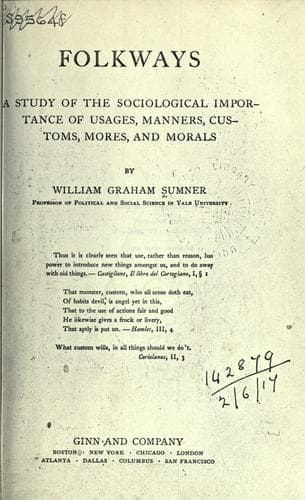
Folkways: A Study of the Sociological Importance of Usages, Manners, Customs, Mores, and MoralsSumner, William Graham
General
Folkways: A Study of the Sociological Importance of Usages, Manners, Customs, Mores, and Morals
Sumner, William Graham
Manners and customs
which they have had no chance to acquire. They also find it very
difficult to understand or interpret a picture, even of the least
conventional kind.[229] The Seri of Tiburon Island have not the knife
habit. They draw a knife towards the body instead of pushing it
away.[230] Hence we see that the lack of a habit, or lack of opportunity
to see a dexterity practiced, constitutes a narrowing of the mental
horizon.
+133. Fire-making tools.+ Another art which would offer us parallel
phenomena to that of stone working is that of fire making. It must have
had several independent centers of origin. It existed all over the
globe. Its ultimate origin is unknown to us. It may have originated in
different ways at different centers. The simplest instruments for making
fire can be classified according to the mode of movement employed in
them as drilling, plowing, and sawing instruments. The fire drills have
also undergone very important development and improvement, so that they
have become very complicated machines. The ingenuity and inventive skill
which were required to make a fire drill which was driven by a bow were
as great as the same powers when manifested by an Edison or a Bessemer.
+134. Psychophysical traits of primitive men.+ All the artifacts were
made and all the arts were produced by the concurrent efforts of men to
serve their interests. We find that primitive men put patient effort and
astonishing ingenuity into their tools. They also attained to great
skill in the use of clumsy tools. It is true, in general, of primitive
men that they shirk all prolonged effort or patient application, but
they do use great patience and perseverance when they expect to
accomplish something of great importance to their interests. The same is
true if they expect to gratify their vanity. In hair dressing or
tattooing they submit to very irksome restraint prolonged through a long
time. Also in feather work, partly useful and partly ornamental, they
assorted feathers piece by piece, and enlaced the feathers in the meshes
of their hats and caps, or fastened them into scepters with pitch. They
could make houses, etc., with their axes only by long-continued
industry.[231] South American Indians made tools for printing tattoo
patterns on the body. They were blocks, on each face of which a pattern
was raised, perhaps a different one on each side.[232] It should be
noticed what prodigious power a large body of men can put forth when
they all work at the same task and are greatly interested in it. They
begin by the same process, but the process differentiates and improves
in their hands. Each gains skill and dexterity. They learn from each
other, and the product is multiplied.
Public-domain text, read in full here on John Shaqi.
Reviews
Reviews
No reviews yet
Be the first to share your thoughts on this work.
Elsewhere in the archive
Join the Discussion
Join the discussion
Sign in to leave a comment or review.
Sign InorCreate an account