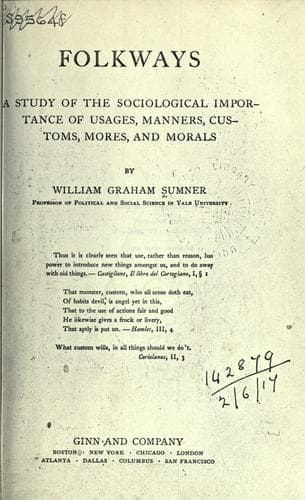
Folkways: A Study of the Sociological Importance of Usages, Manners, Customs, Mores, and MoralsSumner, William Graham
General
Folkways: A Study of the Sociological Importance of Usages, Manners, Customs, Mores, and Morals
Sumner, William Graham
Manners and customs
+135. Language.+ Language is a product of the folkways which illustrates
their operation in a number of most important details. Language is a
product of the need of cooperative understanding in all the work, and in
connection with all the interests, of life. It is a societal phenomenon.
It was necessary in war, the chase, and industry so soon as these
interests were pursued cooperatively. Each group produced its own
language which held that group together and sundered it from
others.[233] All are now agreed that, whatever may have been the origin
of language, it owes its form and development to usage. "Men's usage
makes language." "The maxim that 'usage is the rule of speech' is of
supreme and uncontrolled validity in every part and parcel of every
human tongue."[234] "Language is only the imperfect means of men to find
their bearings in the world of their memories; to make use of their
memory, that is, their own experience and that of their ancestors, with
all probability that this world of memory will be like the world of
reality."[235] The origin of language is one of those origins which must
ever remain enveloped in mystery. "How can a child understand the
combinations of sound and sense when it must know language in order to
learn them? It must learn to speak without previously knowing how to
speak, without any previous suspicion that the words of its mother mean
more than the buzzing of a fly. The child learns to speak from an
absolute beginning, just as, not the original man, but the original
beast, learned to speak before any creature could speak."[236] The
beasts evidently did not learn to speak. They only learned to use the
beast cries, by which they transmitted warnings, sex invitations, calls
to united struggles, etc. The cries answered the purpose and went no
further. Men, by virtue of the expanding power in them which enthused
their zeal and their play, broke through the limitations of beast
language, and went on to use the sounds of the human speech instrument
for ever richer communications. Poetic power in blossom guides the
development of a child's language as it guided that of the men who made
the first languages.[237] "The original languages must be, in
comparison with our languages, like the wildest love-passion compared
with marital custom."[238] Every word has a history of accidents which
have befallen it, the beginnings of which are lost in the abyss of
time.[239] In the Middle Ages the word "Word" came to mean the Word of
God with such distinctness that the romance languages adopted parabola,
or derivatives from it, for "word."[240] The students of linguistics
recognize metaphor as another great mode of modifying the signification
of words. By metaphor they mean the assembling of like things, and the
selection and extirpation of unlike things.
Public-domain text, read in full here on John Shaqi.
Reviews
Reviews
No reviews yet
Be the first to share your thoughts on this work.
Elsewhere in the archive
Join the Discussion
Join the discussion
Sign in to leave a comment or review.
Sign InorCreate an account