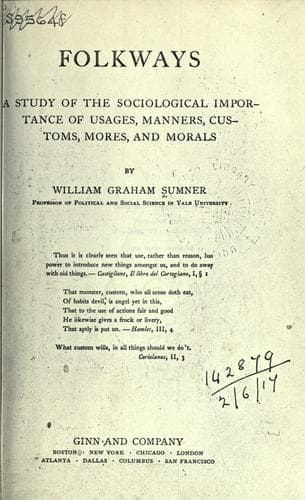
Folkways: A Study of the Sociological Importance of Usages, Manners, Customs, Mores, and MoralsSumner, William Graham
General
Folkways: A Study of the Sociological Importance of Usages, Manners, Customs, Mores, and Morals
Sumner, William Graham
Manners and customs
have been used as ornament. Pieces of quartz and sandstone, rudely
square but with broken corners, from four to five centimeters in
diameter and one and a half to two centimeters thick, rubbed down by
friction, have been found.[294]
+145. Intragroup money from property; intergroup money from trade.+
These cases already show us the distinction between intragroup money and
intergroup money. The effect of trade is to develop one or more
predominant wares. In the intragroup exchanges this is an object of high
desire to individuals for use. It may be an amulet ornament, or a thing
of great use in the struggle for existence, e.g. cattle, or a thing of
universal acceptance by which anything can be obtained. In intergroup
trade it is the chief object of export, the thing for which the trade is
carried on, e.g. salt, metal, fur. If this commodity is not easily
divisible, the money is something which can be given "to boot," e.g.
tobacco, sugar, opium, tea, betel.[295] That is money which will "pass."
This does not mean that which can be forced to pass ("legal tender"),
but that which will go without force. Amulet ornaments may be either a
whim which does not take, or fashion may seize upon something of this
kind and make it a tribe mark. Then it becomes group money, because it
is universally desired. The articles admit of accumulation, and
ostentation is a new joy; they also admit of change and variety. They
are available for gifts to the medicine man (to satisfy ghosts, get
rain, or thwart disease). They may be used to buy a wife, or to buy a
step in the secret society of the men, or to pay a fine or penalty to
the chief. The differentiation of goods starts emotion on the line of
least resistance, and the predominant goods are the ones of widest
demand. Often the predominant ware has a gain from taboo, probably on
account of relation to the dead.[296] A thing which is rare and hard to
get may become intragroup money. In Fiji the teeth of the spermaceti
whale are taken as a measure of value and sign of peace. In German New
Guinea the bent tusks of a boar are used as money. In California red
birds' heads are used in the same way. Trophy skulls of birds and beasts
become a store of wealth, and money with which trade can be carried on
with neighbors.[297] The first step seems to be to use the predominant
article as the third term of reference in barter. Intergroup money is
really a ware and so remains, as gold is now; but groups widen as
communication improves, and group money gets a very wide range. In
intergroup affairs, therefore, the relations sooner become impersonal
and mechanical. The things which are best for this purpose become
mobile. Some are better as stores of value, others as means of power,
others as measures of value. The last are on the way to become money.
The others are more like gems. Thus group money arose from property;
intergroup money from trade.
Public-domain text, read in full here on John Shaqi.
Reviews
Reviews
No reviews yet
Be the first to share your thoughts on this work.
Elsewhere in the archive
Join the Discussion
Join the discussion
Sign in to leave a comment or review.
Sign InorCreate an account