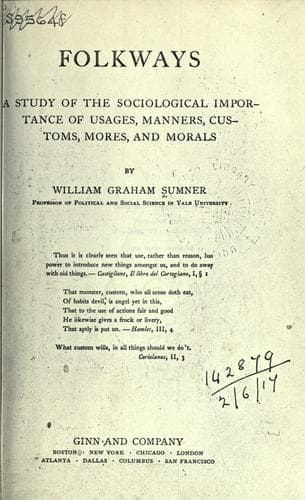
Folkways: A Study of the Sociological Importance of Usages, Manners, Customs, Mores, and MoralsSumner, William Graham
General
Folkways: A Study of the Sociological Importance of Usages, Manners, Customs, Mores, and Morals
Sumner, William Graham
Manners and customs
the former case a multiple standard is available; in the latter case
what is needed to discharge balances is a commodity of universal demand.
When credit is introduced its sphere is intragroup. The debtors would
like the money to be what every one can get. The creditors would like it
to be what every one wants.
+144. Various predominant wares.+ In the northeastern horn of Africa the
units of value which are used as money are salt, metal, skins, cotton,
glass, tobacco, wax, coffee beans, and korarima. Cattle and slaves are
also used as units of value from time to time amongst the Oromo. Salt is
used as money in prismatic pieces, twenty-two centimeters long and three
centimeters to five millimeters broad at the bottom, which weigh from
seven hundred and fifty grams to one and one half kilograms each. It is
carried in bundles of twenty to thirty pieces, wound in leaves.[286] The
Galla use rods of iron six to twelve centimeters long, somewhat thicker
in the middle, well available for lance ends, one hundred and thirty of
which are worth one thaler in Schoa; also pieces of copper, tin, and
zinc; calf-skins; black, printed, and unprinted cotton cloth; pieces of
cloth; coarse red cotton yarn (for knitting); and strings of beads. The
universal and intergroup money is the Maria Theresa thaler weighing
571.5 to 576 English grains.[287] Cameron mentions the exchange of
intergroup money for intragroup money at a fair at Kawile, on the
eastern shore of Lake Tanganyika. At the opening of the fair the money
changers gave out the local money of bugle beads, which they took in
again when the fair closed.[288] On the French Congo the boatmen were
paid with paper bons, which were superseded by metal ones in 1887. When
the recipient takes his bon to the station he obtains at first a number
of nails, beads, or other articles for it, which he can then exchange
for what he wants. Tokens of copper are issued at Franceville, stamped
"F," of different shapes and sizes, but always of the same shape and
size for the same value in French money.[289] At Grand Bassam in West
Africa the manilla (bracelet) serves as money. For six months the
natives give oil for these bracelets of metal mixed of copper, lead,
zinc, antimony, and iron, which can be closed around the arm or leg of a
slave by a blow of the hammer. Then for six months they exchange the
bracelets for the European goods which they want.[290] These bracelets
were a store of wealth for the black men.[291] The Kru have few cattle,
which pass from one to another in bride purchases, since these can be
made with nothing else. It is impossible to have wives and cattle too
until one's daughters grow up.[292] Since the seventeenth century
cylindrical (bugle) green-blue beads have been money on the ivory and
gold coasts. They come from an ancient cemetery on the Bokabo Mountains
and are of Egyptian origin. They were buried with the dead.[293] A local
money of stone is reported also from Avetime in Ehveland. It is said to
Public-domain text, read in full here on John Shaqi.
Reviews
Reviews
No reviews yet
Be the first to share your thoughts on this work.
Elsewhere in the archive
Join the Discussion
Join the discussion
Sign in to leave a comment or review.
Sign InorCreate an account