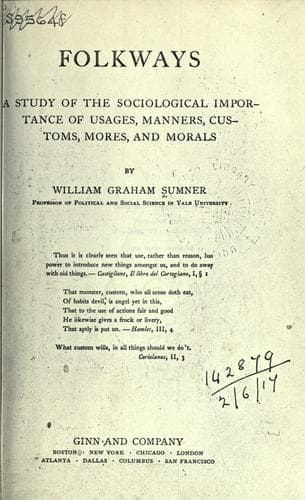
Folkways: A Study of the Sociological Importance of Usages, Manners, Customs, Mores, and MoralsSumner, William Graham
General
Folkways: A Study of the Sociological Importance of Usages, Manners, Customs, Mores, and Morals
Sumner, William Graham
Manners and customs
+147. Token money.+ Token money demands treatment by itself, as a
special development of the money-producing movement. If different groups
adopt different kinds of amulet ornaments as money, such intragroup
money may be token money. If one such group conquers another, the
conquerors may throw the money of the conquered out of use (whites and
Indians as to wampum). In Burma Chinese gambling counters are used as
money.[308] Guttapercha tokens issued by street-car companies in South
America are said to be used in the same way. Postage stamps, milk
tickets, etc., have been so used by us. In Massachusetts, in the
eighteenth century, pieces of paper were circulated which had no
redemption whatever. They bore the names of coins of silver which did
not exist, but which had a definition in a certain amount of silver of a
certain fineness. At Carthage pieces of leather which inclosed an
unknown object, probably one of the holy moneys, were circulated.[309]
The same is reported of bits of leather cut, like samples, from a skin
and circulated in place of it. The device succeeded for the in-group
money, but it led to the attempt to put copper tokens in the place of
silver coins, which resulted in disaster.[310] The cacao beans of Mexico
were wares, if of good quality. Larger ones of poorer quality were
money. A part of the value was imaginary. Cloth was formerly money in
Bohemia. A loosely woven variety of cloth was used for this purpose, the
cloth utilities as a textile fabric and as money being separated. On the
west coast of Africa little mats were used as money. They were stamped
by the Portuguese government. Mat money was also used on the New
Hebrides, especially to buy grades in the great secret society. The mats
are long and narrow and are more esteemed when they are old and black
from the smoke of the huts. They are kept in little houses where they
are smoked. "When they hang with soot they are particularly
valued."[311] Useless broken rice is used as money in Burma and
elsewhere in the East.[312] The use of token money, in which a part of
the value is imaginary, always implies the inclosure of a group and the
exclusion of foreign trade. Then, within the group, the value may be
said to be real and not imaginary. It depends on the monopoly law of
value and varies with the quantity but not proportionately to the
quantity. Kublai-Khan, using a Chinese device, got possession of all the
gold and silver and issued paper. His empire was so great that all trade
was intragroup trade, and his power made his paper money pass.[313]
The Andamanese made inferior pots to be used as a medium in barter.[314]
They have very little trade; are on a stage of mutual gift making.[315]
Token money is an aberration of the folkways, due to misapprehension of
the peculiarity of group money. At the same time it has been used with
advantage for subsidiary silver coinage.
Public-domain text, read in full here on John Shaqi.
Reviews
Reviews
No reviews yet
Be the first to share your thoughts on this work.
Elsewhere in the archive
Join the Discussion
Join the discussion
Sign in to leave a comment or review.
Sign InorCreate an account