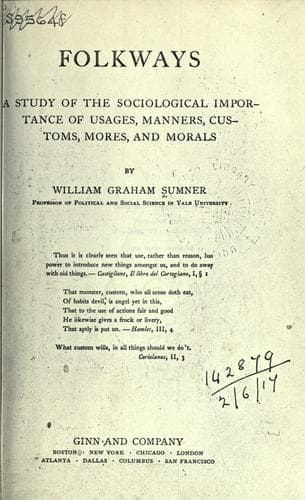
Folkways: A Study of the Sociological Importance of Usages, Manners, Customs, Mores, and MoralsSumner, William Graham
General
Folkways: A Study of the Sociological Importance of Usages, Manners, Customs, Mores, and Morals
Sumner, William Graham
Manners and customs
kind.[353] If the sacrificer wished to redeem his animal, etc.,
he must pay twenty per cent more than the priest's assessment of
it.[354] Until the Exile the precious metals were paid by
weight.[355] The rings represented on the Egyptian monuments were
of wire with a round section. Those found by Schliemann at Mykenae
are similar, or they are spirals of wire.[356] In Homer cattle
are the unit of value, but metals are used as media. The talent
is mentioned only in reference to gold.[357] Possibly Schurz is
right in supposing that fluctuations in the value of cattle and
sheep forced the classical nations to use metal.[358] The metals
were in the shape of caldrons or tripods, in which fines were
imposed. They may have been accumulated because used as money, or
a great man who had many clients may have needed many for
meals.[359] "The transition from the old simple mode of exchange
to the use of currency can nowhere be better traced than amongst
the Romans." Fines were set in cattle or sheep, but copper was
used as well, weighed when sold. Then the state set the shape and
fineness of the bars and stamped them with the mark of a sheep or
ox. Later the copper was marked to indicate its value, and so
money was reached.[360] Amongst Germans and Scandinavians the cow
was the primitive unit of value.[361] It was superseded by metals
used in rings to make out the fractions.[362]
+154. The evolution of money.+ It is evident that money was developed
out of trade by instinctive operations of interest, and that money
existed long before the idea of it was formed. The separate operations
were stimulated only by the most immediate and superficial desires, but
they set supply and demand in motion and produced economic value
thousands of years before any man conceived of value. The rational
analysis of value and money is not yet satisfactorily made. There are,
therefore, points of view in which money is the most marvelous product
of the folkways. The unconsciousness of the operation and the secondary
results of it are here in the strongest contrast. Inside of the we-group
useful property was shared or exchanged in an infinite variety of ways,
according to variations of circumstances. We cannot follow the customs
which thence arose, because the phenomena have been reported to us
without distinction between intragroup and intergroup transactions. We
see groups of predominant wares set out in intergroup trade, and only
slowly is a smaller number segregated to be the general terms of every
trade. The inconvenience of barter was only slowly felt, and could not
have been a motive until trade was customary and familiar. In intragroup
exchanges the predominant ware was more easily differentiated. It was
the thing greatly desired. Here the amulet-trophy-ornament was important
for the elements of superstition, vanity, and magic which it bore. In
intergroup trade the utility of the object predominated.
Public-domain text, read in full here on John Shaqi.
Reviews
Reviews
No reviews yet
Be the first to share your thoughts on this work.
Elsewhere in the archive
Join the Discussion
Join the discussion
Sign in to leave a comment or review.
Sign InorCreate an account