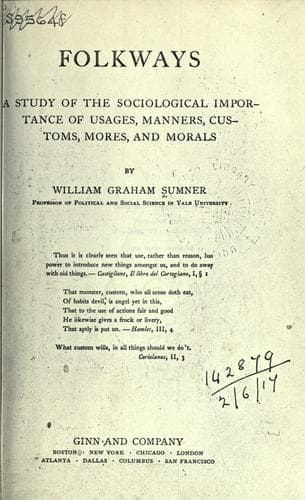
Folkways: A Study of the Sociological Importance of Usages, Manners, Customs, Mores, and MoralsSumner, William Graham
General
Folkways: A Study of the Sociological Importance of Usages, Manners, Customs, Mores, and Morals
Sumner, William Graham
Manners and customs
It was sought
in journeys only for its utility, and in that trade the transactions
first became impersonal. In the selection of leading wares individuals
could not experiment for their own risk. By taking what each wanted at a
time selection at last resulted, and when we are told that a certain
group uses this or that group of articles for money, we are told only
what articles predominate in their desires or transactions; in other
words, what stage in the selection of a money they have reached. It is
evident that this entire operation was an impersonal and unregulated
play of custom, which went through a long and varying evolution, but
kept its authority all the time and at every stage. The persistence of
the word "shilling" in our language is a striking proof of the power of
custom--above all, popular custom--in connection with money. The metric
system was invented to be a rational system, but the populace has
insisted on dividing kilograms and liters into halves and quarters.
Language, money, and weights and measures are things which show the
power of popular custom more than any others. The selection of
predominant wares reached its acme in the selection of _one_, not
necessarily the commodity most desired, but, after the function of money
is perceived, the one which performs it best. To return and take up a
greater number is to go backward on the path of civilization.
+155. The ethical functions of money.+ From shells to gold the ethics of
social relations has clung to money. There is more pure plutocracy in
Melanesia than in New York. The differentiation of men by wealth is
greatly aided by money, because money adds immensely to the mobility of
wealth and lets all forces reach their full effect in transactions. The
social effect of debt is best seen in barbarous societies which have
money. Debt and war together made slavery.[363] It is, however, an
entire mistake to regard a money-system as in itself a mischief-working
system. The effect of money is exhausted when we notice that it makes
wealth mobile and lets forces work out their full result by removing
friction. So soon as there is a money there is a chance for exchanges of
money for goods and goods for money, also for the loan and repayment of
money at different times, under which transactions interests may change
and speculation can arise. These facts have always interested the
ethical philosophers. "Naught hath grown current amongst mankind so
mischievous as money. This brings cities to their fall. This drives men
homeless, and moves honest minds to base contrivings. This hath taught
mankind the use of villainies, and how to give an impious turn to every
kind of act."[364] In such diatribes "money" stands for wealth in
general. Money, properly speaking, has no more character than axes of
stone, bronze, iron, or steel. It only does its own work impersonally
and mechanically. The ethical functions and character ascribed to it are
entirely false.
Public-domain text, read in full here on John Shaqi.
Reviews
Reviews
No reviews yet
Be the first to share your thoughts on this work.
Elsewhere in the archive
Join the Discussion
Join the discussion
Sign in to leave a comment or review.
Sign InorCreate an account