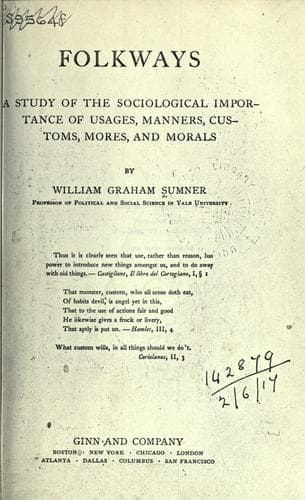
Folkways: A Study of the Sociological Importance of Usages, Manners, Customs, Mores, and MoralsSumner, William Graham
General
Folkways: A Study of the Sociological Importance of Usages, Manners, Customs, Mores, and Morals
Sumner, William Graham
Manners and customs
There can be no such thing as "tainted money." Money
bears no taint. It serves the murderer and the saint with equal
indifference. It is a tool. It can be used one day for a crime, the next
day for the most beneficent purpose. No use leaves any mark on it. The
Solomon Islanders are expert merchants and "are fully the equal of white
men in cheating."[365] They do it with shell money as whites do it with
gold, silver, and banknotes. That is to say, the "money" is indifferent
because it has no ethical function at all and absolutely no character.
+156.+ There are other topics which might be brought under the struggle
for existence as a cluster of folkways, with great advantage. The
struggle for existence takes on many different forms and produces
phenomena which are cases of folkways. It speedily develops industrial
organization, which, in one point of view, is only the interaction of
folkways. Weights and measures, the measurement of time, the
communication of intelligence, and trade are primary folkways in their
earliest forms and deserve careful study as such.
[165] Smyth, _Aborig. of Victoria_, I, 194, 197.
[166] Mason, _Origin of Invention_, 252.
[167] Tylor, _Anthrop._, 208.
[168] Powers, _California Indians_, 50.
[169] Lumholtz, _Scribner's_, October, 1894, 448.
[170] Von den Steinen, _Berl. Mus._, 1888, 205.
[171] Southey, _Brazil_, I, 131.
[172] E.g. a rasp made from the skin of the palate of a kind of
ray, by Tahitians, Vienna Museum.
[173] Mason, _Origin of Invention_, 23.
[174] Grinnell, _Folk Tales_, 295.
[175] Dall, _Bur. Eth._, III, 122.
[176] Ratzel, _Voelkerkunde_, II, 52.
[177] Smyth, _Aborig. of Victoria_, I, 202.
[178] _N. S. Amer. Anthrop._, II, 466.
[179] _U. S. Nat. Mus._, 1890, 471.
[180] Ratzel, _Voelkerkunde_, II, 163.
[181] Smithson, _Contrib. to Knowledge_, XXV; Rau, _Prehist.
Fishing_.
[182] Von den Steinen, _Berl. Mus._, 1888, 209, 231, 235.
[183] Ehrenreich, _Voelkerkunde Brasiliens; Berl. Mus._, 1891, 57.
[184] _Prim. Inhab. of Scandinavia_, 35.
[185] JAI, XXIII, 160.
[186] _Ibid._, XXVIII, 343.
[187] Kabary, _Karolinenarchipel._, 123-130.
[188] Hearn, _Japan_, 139.
[189] _Ibid._, 165.
[190] Smyth, _Aborig. of Victoria_, I, 340.
[191] Tylor, JAI, XXII, 137; JAI, XXIV, 336; _Early Hist. of
Mankind_, 195; Ling Roth, _Tasmania_, 158.
[192] JAI, XXIII, 276.
[193] _Bur. Eth._, XVII (Part I), 153, 245.
[194] _Ibid._, XV, 61.
[195] Mason, _Origin of Invention_, 132.
[196] _Ibid._, 123, 136.
[197] _Intern. Cong. Anthrop._, 1893, 67.
[198] JAI, XXIV, 44.
[199] _Ibid._, X, 316.
[200] Mason, _Origin of Invention_, 148.
[201] Ratzel, _Voelkerkunde_, II, 586.
[202] Ranke, _Der Mensch_, II, 519.
[203] Ratzel, _Voelkerkunde_, II, 149.
[204] Hagen, _Unter den Papuas_, 214; Pfeil, _Aus der Suedsee_,
97.
Public-domain text, read in full here on John Shaqi.
Reviews
Reviews
No reviews yet
Be the first to share your thoughts on this work.
Elsewhere in the archive
Join the Discussion
Join the discussion
Sign in to leave a comment or review.
Sign InorCreate an account