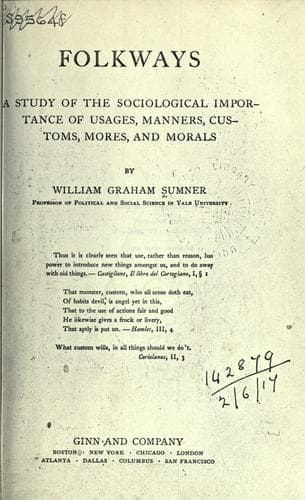
Folkways: A Study of the Sociological Importance of Usages, Manners, Customs, Mores, and MoralsSumner, William Graham
General
Folkways: A Study of the Sociological Importance of Usages, Manners, Customs, Mores, and Morals
Sumner, William Graham
Manners and customs
+161. Modern view of labor.+ It is only in the most recent times, and
imperfectly as yet, that labor has been recognized as a blessing, or, at
worst, as a necessity which has great moral and social compensations,
and which, if rightly understood and wisely used, brings joy and
satisfaction. This can only be true, however, when labor is crowned by
achievement, and that is when it is productive of wealth. Labor for the
sake of labor is sport. It has its limits, and lies outside of the
struggle for existence, which is real, and is not play. Labor in the
struggle for existence is irksome and painful, and is never happy or
reasonably attractive except when it produces results. To glorify labor
and decry wealth is to multiply absurdities. The modern man is set in a
new dilemma. The father labors, wins, and saves that his son may have
wealth and leisure. Only too often the son finds his inheritance a
curse. Where is the error? Shall the fathers renounce their labors?
+162. Movable capital in modern society.+ +Conditions of equality.+
+Present temporary status of the demand for men.+ In modern times
movable capital has been immensely developed and even fixed capital has
been made mobile by the joint-stock device. It has disputed and largely
defeated the social power of land property. It has become the social
power. While land owners possessed the great social advantage, they
could form a class of hereditary nobles. The nobles now disappear
because their social advantage is gone. The modern financiers, masters
of industry, merchants, and transporters now hold control of movable
capital. They hold social and political power. They have not yet formed
a caste of nobles, but they may do so. They may, by intermarriages,
absorb the remnants of the old nobility and limit their marriages
further to their own set. It is thus that classes form and reform, as
new groups in the society get possession of new elements of social
power, because power produces results. The dogmas of philosophers deal
with what ought to be. What is and shall be is determined by the forces
at work. No forces appear which make men equal. Temporary conditions
occur under which no forces are at work which any one can seize upon.
Then no superiority tells, and all are approximately equal. Such
conditions exist in a new colony or state, or whenever the ratio of
population to land is small. If we take into account the reflex effect
of the new countries on Europe, it is easy to see that the whole
civilized world has been under these conditions for the last two hundred
or three hundred years. The effect of the creation of an immense stock
of movable capital, of the opportunities in commerce and industry
offered to men of talent, of the immense aid of science to industry, of
the opening of new continents and the peopling of them by the poorest
and worst in Europe, has been to produce modern mores. All our popular
faiths, hopes, enjoyments, and powers are due to these great changes in
Public-domain text, read in full here on John Shaqi.
Reviews
Reviews
No reviews yet
Be the first to share your thoughts on this work.
Elsewhere in the archive
Join the Discussion
Join the discussion
Sign in to leave a comment or review.
Sign InorCreate an account