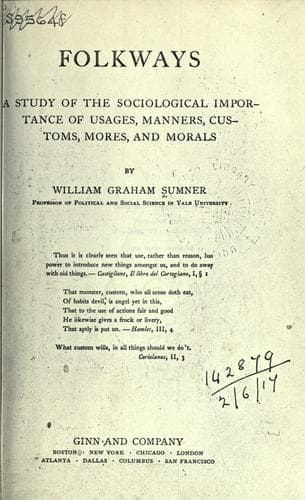
Folkways: A Study of the Sociological Importance of Usages, Manners, Customs, Mores, and MoralsSumner, William Graham
General
Folkways: A Study of the Sociological Importance of Usages, Manners, Customs, Mores, and Morals
Sumner, William Graham
Manners and customs
the conditions of life. The new status makes us believe in all kinds of
rosy doctrines about human welfare, and about the struggle for existence
and the competition of life; it also gives us all our contempt for
old-fashioned kings and nobles, creates democracies, and brings forth
new social classes and gives them power. For the time being things are
so turned about that numbers are a source of power. Men are in demand,
and an increase in their number increases their value. Why then should
we not join in dithyrambic oratory, and set all our mores to optimism?
The reason is because the existing status is temporary and the
conditions in it are evanescent. That men should be in demand on the
earth is a temporary and passing status of the conjuncture which makes
things now true which in a wider view are delusive. These facts,
however, will not arrest the optimism, the self-confidence, the joy in
life, and the eagerness for the future, of the masses of to-day.
+163. Effect of the facility of winning wealth.+ All the changes in
conditions of life in the last four hundred years have refashioned the
mores and given modern society new ideas, standards, codes,
philosophies, and religions. Nothing acts more directly on the mores
than the facility with which great numbers of people can accumulate
wealth by industry. If it is difficult to do so, classes become fixed
and stable. Then there will be an old and stiff aristocracy which will
tolerate no upstarts, and other classes will settle into established
gradations of dependence. The old Russian boyars were an example of such
an aristocracy. Certain mediaeval cities ran into this form. In it the
mores of conservatism are developed,--unchangeable manners, fixed usages
and ideas, unenlightenment, refusal of new ideas, subserviency of the
lower classes, and sycophancy. The government is suspicious and cruel.
If it is easily possible to gain wealth, a class of upstart rich men
arises who, in a few years, must be recognized by the aristocracy,
because they possess financial power and are needed. Struggles and civil
wars may occur, as in the Italian cities, during this change, and the
old aristocracy may long hold aloof from the new. In time, the new men
win their way. The history of every state in Europe proves it. Old
fortunes decay and old families die out. The result is inevitable. Laws
and institutions cannot prevent it. Certain mores may have been
recognized as aristocratic and there may be lamentations over their
decline. They are poetic, romantic, and adventurous. Therefore they call
out regret for their loss from those who do not think what would come
back with them if they were recalled. Ethical philosophers may see ample
reason to doubt the benefit of new mores and the vulgarization of
everything. Society cannot stand still, and its movement will run the
course set by the forces which produce it. It must be accepted and
profit must be drawn from it, as best possible.
Public-domain text, read in full here on John Shaqi.
Reviews
Reviews
No reviews yet
Be the first to share your thoughts on this work.
Elsewhere in the archive
Join the Discussion
Join the discussion
Sign in to leave a comment or review.
Sign InorCreate an account