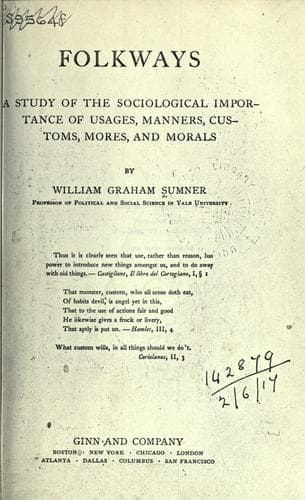
Folkways: A Study of the Sociological Importance of Usages, Manners, Customs, Mores, and MoralsSumner, William Graham
General
Folkways: A Study of the Sociological Importance of Usages, Manners, Customs, Mores, and Morals
Sumner, William Graham
Manners and customs
Social selection by the mores.--Instrumentalities of
suggestion.--Symbols, pictures, etc.--Apparatus of
suggestion.--Watchwords, catchwords.--"Slave," "democracy."--
Epithets.--Phrases.--Pathos.--Pathos is unfavorable to
truth.--Analysis and verification as tests.--Humanity.--
Selection by distinction.--Aristocracies.--Fashion.--
Conventionalization.--Uncivilized fashions.--Ideals of
beauty.--Fashion in other things than dress.--Miscellaneous
fashions.--All deformations by fashion are irrational.--Satires
on fashion.--Fashion in faiths and ideals.--Fashion is not
trivial, not subject to argument.--Remoter effects of fashion.--
Slang and expletives.--Poses, fads, and cant.--Illustrations.--
Heroes, scapegoats, and butts.--Caricature.--Relation of fads,
etc., to mores.--Ideals.--Ideals of beauty.--The
man-as-he-should-be.--The standard type of man.--Who does the
thinking?--The gentleman.--Standards set by taboos.--Crimes.--
Criminal law.--Mass phenomena of fear and hope.--Manias,
delusions.--Monstrous mass phenomena.--Gregariousness in the
Middle Ages.--The mendicant orders.--Other mendicants.--
Popular mania for poverty and beggary.--Delusions.--Manias and
suggestion.--Power of the crowd over the individual.--
Discipline by pain.--The mediaeval church operated societal
selection.--The mediaeval church.--Sacerdotal celibacy.--The
masses wanted clerical celibacy.--Abelard.--The selection of
sacerdotal celibacy.--How the church operated selection.--Mores
and morals; social code.--Orthodoxy; treatment of dissent;
selection by torture.--Execution by burning.--Burning in North
American colonies.--Solidarity in penalty for fault of one.--
Torture in the ancient states.--Torture in the Roman empire.--
Jewish and Christian universality; who persecutes whom?--The
ordeal.--Irrationality of torture.--Inquisitorial procedure
from Roman law.--Bishops as inquisitors.--Definition of
heretic.--The Albigenses.--Persecution was popular.--Theory of
persecution.--Duties laid on the civil authority.--Public
opinion as to the burning of heretics.--The shares of the church
and the masses.--The church uses its power for selfish
aggrandizement.--The inquisition took shape slowly.--Frederick
II and his code.--Formative legislation.--Dungeons.--The
yellow crosses.--Confiscation.--Operation of the inquisition.--
Success of the inquisition.--Torture in civil and ecclesiastical
trials.--The selection accomplished.--Torture in England.--The
Spanish inquisition.--The inquisition in Venice.--The use of
the inquisition for political and personal purposes.--Stages of
the selection by murder.
Public-domain text, read in full here on John Shaqi.
Reviews
Reviews
No reviews yet
Be the first to share your thoughts on this work.
Elsewhere in the archive
Join the Discussion
Join the discussion
Sign in to leave a comment or review.
Sign InorCreate an account