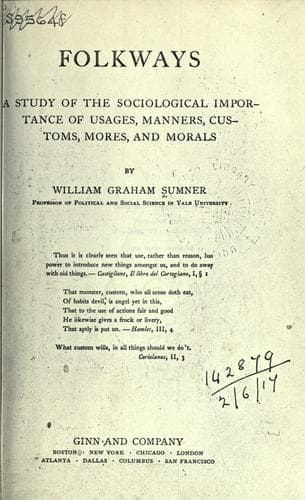
Folkways: A Study of the Sociological Importance of Usages, Manners, Customs, Mores, and MoralsSumner, William Graham
General
Folkways: A Study of the Sociological Importance of Usages, Manners, Customs, Mores, and Morals
Sumner, William Graham
Manners and customs
+168. The standard of living.+ One of the purest of all the products of
current mores is the standard of living. It belongs to a subgroup and is
a product of the mores of a subgroup. It has been called a psychological
or ethical product, which view plainly is due to an imperfect analysis
or classification. The standard of living is the measure of decency and
suitability in material comfort (diet, dress, dwelling, etc.) which is
traditional and habitual in a subgroup. It is often wise and necessary
to disregard the social standard of comfort, because it imposes foolish
expenses and contemptible ostentation, but it is very difficult to
disregard the social standard of comfort. The standard is upheld by fear
of social disapproval, if one derogates from class "respectability." The
disapproval or contempt of one's nearest associates is the sanction. The
standards and code of respectability are in the class mores. They get
inside of the mind and heart of members of the class, and betray each to
the class demands.
+169.+ If, however, the standard of living which one has inherited from
his class is adopted as an individual standard, and is made the object
of effort and self-denial, the individual and social results are of
high value. One man said, "Live like a hog and you will behave like
one"; to which another replied, "Behave like a hog and you will live
like one." Both were right in about equal measure. The social standard
of a class acts like honor. It sustains self-respect and duty to self
and family. The pain which is produced by derogation produces effort and
self-denial. The social standard may well call out and concentrate all
there is in a man to work for his social welfare. Evidently the
standard of living never can do more than that. It never can add
anything to the forces in a man's own character and attainments.
[366] Prov. xxiv. 30.
[367] _Jewish Encyc._, s.v. "Labor." The same view is found in 2
Thess. iii. 10, and Eph. iv. 28.
[368] Thomas Aquinas, _Summa_, II, 2, qu. 82, 1, 2; qu. 187, 3.
[369] D'Avenel, _Hist. Econ._, 142.
[370] D'Avenel, 397.
[371] D'Avenel, 144.
[372] Hardy used this fact in _Tess of the D'Urbervilles_.
CHAPTER V
SOCIETAL SELECTION
Public-domain text, read in full here on John Shaqi.
Reviews
Reviews
No reviews yet
Be the first to share your thoughts on this work.
Elsewhere in the archive
Join the Discussion
Join the discussion
Sign in to leave a comment or review.
Sign InorCreate an account