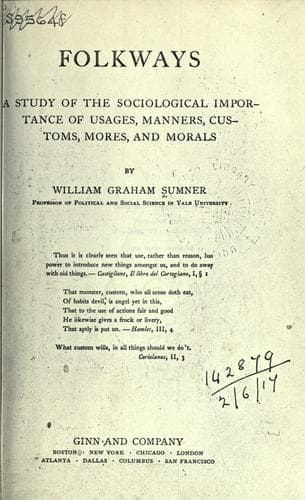
Folkways: A Study of the Sociological Importance of Usages, Manners, Customs, Mores, and MoralsSumner, William Graham
General
Folkways: A Study of the Sociological Importance of Usages, Manners, Customs, Mores, and Morals
Sumner, William Graham
Manners and customs
former is the effect most likely to be produced on the masses, the
latter on the cultured classes. In the Greco-Roman world, at the
beginning of the Christian era, various philosophic sects tried to
restore and renew the ideals of Greek heroism, virtue, and religious
faith, so far as they seemed to have permanent ethical value. The
popular mores were never touched by this effort. In fact, it is
impossible for us to know whether the writings of Seneca, Plutarch,
Marcus Aurelius, Epictetus, and Pliny represent to us the real rules of
life of those men, or are only a literary pose. In the Renaissance, and
since then, men educated in the classics have been influenced by them in
regard to their standards of noble and praiseworthy character, and of
what should be cultivated in thought and conduct. Such men have had a
common stock of quotations, of accepted views in life philosophy, and of
current ethical opinions. This stock, however, has been common to the
members of the technical guild of the learned. It has never affected the
masses. Amongst Protestants the Bible has, in the last four hundred
years, furnished a common stock of history and anecdote, and has also
furnished phrases and current quotations familiar to all classes. It has
furnished codes and standards which none dared to disavow, and the
suggestion of which has been overpowering. The effect on popular mores
has been very great.
+172. Symbols, pictures.+ Before the ability to read became general art
was employed in the form of symbols to carry suggestion. Symbolic acts
were employed in trade and contracts, in marriage and religion. For us
writing has taken the place of symbols as a means of suggestion. Symbols
do not appeal to us. They are not in our habits. Illustrative pictures
influence us. The introduction of them into daily newspapers is an
important development of the arts of suggestion. Mediaeval art in colored
glass, carving, sculpture, and pictures reveals the grossness and crass
simplicity of the mediaeval imagination, but also its childish
originality and directness. No doubt it was on account of these latter
characteristics that it had such suggestive power. It was graphic. It
stimulated and inflamed the kind of imagination which produced it. It
found its subjects in heaven, hell, demons, torture, and the scriptural
incidents which contained any horrible, fantastic, or grotesque
elements. The crucifix represented a man dying in the agony of torture,
and it was the chief symbol of the religion. The suggestion in all this
art produced barbaric passion and sensuality. Any one who, in childhood,
had in his hands one of the old Bibles illustrated by wood cuts knows
what power the cuts had to determine the concept which was formed from
the text, and which has persisted through life, in spite of later
instruction.
Public-domain text, read in full here on John Shaqi.
Reviews
Reviews
No reviews yet
Be the first to share your thoughts on this work.
Elsewhere in the archive
Join the Discussion
Join the discussion
Sign in to leave a comment or review.
Sign InorCreate an account