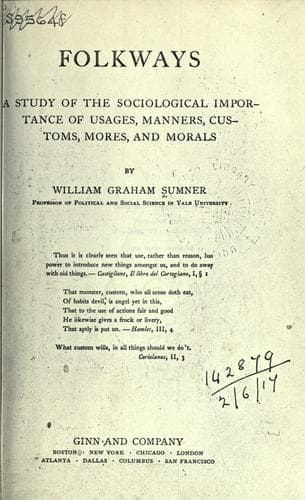
Folkways: A Study of the Sociological Importance of Usages, Manners, Customs, Mores, and MoralsSumner, William Graham
General
Folkways: A Study of the Sociological Importance of Usages, Manners, Customs, Mores, and Morals
Sumner, William Graham
Manners and customs
+173. Apparatus of suggestion.+ In modern times the apparatus of
suggestion is in language, not in pictures, carvings, morality plays, or
other visible products of art. Watchwords, catchwords, phrases, and
epithets are the modern instrumentalities. There are words which are
used currently as if their meaning was perfectly simple, clear, and
unambiguous, which are not defined at all. "Democracy," the "People,"
"Wall Street," "Slave," "Americanism," are examples. These words have
been called "symbols." They might better be called "tokens." They are
like token coins. They "pass"; that is their most noteworthy
characteristic. They are familiar, unquestioned, popular, and they are
always current above their value. They always reveal the invincible
tendency of the masses to mythologize. They are personified and a
superhuman energy is attributed to them. "Democracy" is not treated as a
parallel word to aristocracy, theocracy, autocracy, etc., but as a
Power from some outside origin, which brings into human affairs an
inspiration and energy of its own. The "People" is not the population,
but a creation of mythology, to which inherent faculties and capacities
are ascribed beyond what can be verified within experience. "Wall
Street" takes the place which used to be assigned to the devil. What is
that "Wall Street" which is currently spoken of by editors and public
men as thinking, wanting, working for, certain things? There is a
collective interest which is so designated which is real, but the
popular notion under "Wall Street" is unanalyzed. It is a phantasm or a
myth. In all these cases there is a tyranny in the term. Who dare
criticise democracy or the people? Who dare put himself on the side of
Wall Street? The tyranny is greatest in regard to "American" and
"Americanism." Who dare say that he is not "American"? Who dare
repudiate what is declared to be "Americanism"? It follows that if
anything is base and bogus it is always labeled "American." If a thing
is to be recommended which cannot be justified, it is put under
"Americanism." Who does not shudder at the fear of being called
"unpatriotic"? and to repudiate what any one chooses to call "American"
is to be unpatriotic. If there is any document of Americanism, it is the
Declaration of Independence. Those who have Americanism especially in
charge have repudiated the doctrine that "governments derive their just
powers from the consent of the governed," because it stood in the way of
what they wanted to do. They denounce those who cling to the doctrine as
un-American. Then we see what Americanism and patriotism are. They are
the duty laid upon us all to applaud, follow, and obey whatever a ruling
clique of newspapers and politicians chooses to say or wants to do.
"England" has always been, amongst us, a kind of counter token, or token
of things to be resisted and repudiated. The "symbols," or "tokens,"
always have this utility for suggestion. They carry a coercion with them
Public-domain text, read in full here on John Shaqi.
Reviews
Reviews
No reviews yet
Be the first to share your thoughts on this work.
Elsewhere in the archive
Join the Discussion
Join the discussion
Sign in to leave a comment or review.
Sign InorCreate an account